
A filling helps to restore a tooth damaged by decay to its normal function and shape and helps to prevent further decay by eliminating areas where bacteria can enter the tooth.
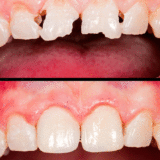
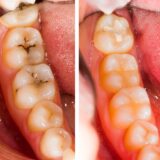
Different types of Filling Material
- Glass Ionomer Cement
- Miracle Mix
- Composite (Tooth Color)
Cost of dental filling ranges from NPR 1500 to NPR 5000 depending upon size of cavity. For recent prices of fillings please Visit Prices / Services Page
Duration for a filling
- It all depends on the type of cavity, the material used, chewing habits.
- Dental Fillings are durable but might not last forever
Things to be followed after filling the tooth
- Do not eat food for about 30 mins after the filling procedure.
- Do not chew from the side of filled tooth for 24 hrs.
- Chew slowly and bite lightly.
- Skip sticky foods.
- Avoid very hot or cold drinks for next 24 hrs
- Avoid sugary foods.
- Do not chew nuts, hard candy.
What could happen if you don’t do dental fillings?
- Increased sensitivity
- Painful unexpected dental emergencies
- Toothache
- Gum diseases
- Cavities in more teeth
- Root canal treatment
- Bigger dental bills
Hence, It’s best to treat a cavity with a small dental filling before you’re in pain.
Deep Caries Management (DCM)
Deep carious lesion is a clinical diagnosis that is given when the caries process has penetrated deep into the dentin with possible pulpal exposure.
It causes pulpal inflammation i.e. pulpitis. If not managed, they may result in pulpal necrosis and involvement of periradicular tissues causing pain and requiring endodontic treatment or extraction.
DCM can be done by following methods:
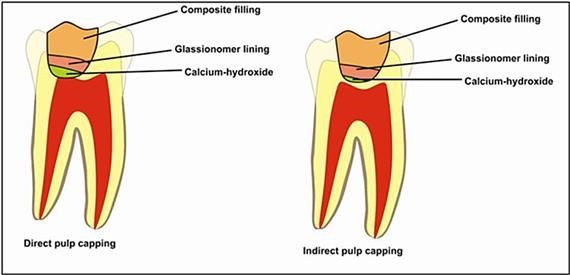
- Indirect pulp capping
- Direct pulp capping
Indirect pulp capping:
This procedure is performed in a tooth with deep carious lesions adjacent to the pulp. In this procedure, all infected carious dentin is removed leaving behind small carious dentin near the pulp to avoid its exposure and the preparation is covered with a biocompatible material.
Direct pulp capping:
This procedure involves the placement of biocompatible material over accidentally exposed pulp during cavity preparation.
Clinical procedure:
- Band the tooth if grossly decayed
- Remove the soft caries with spoon excavator or round bur leaving some caries near the pulp to avoid its exposure in case of indirect pulp capping
- In case of direct pulp capping when there is accidental exposure of the pulp, clean the area with distilled water or saline solution
- Then in both the cases apply liner (i.e. MTA or calcium hydroxide), then place glass ionomer cement as temporary filling.
- After 4 weeks removed the filling gently and if there is reparative dentin formation then permanent filling with composite material is done
- If not then proceed with root canal treatment
Benefits of using Mineral Trioxide Aggregate (MTA) as liner:
- This material has good long term sealing capabilities, and some studies show greater success than other materials
- Excellent material of choice for direct vital pulp exposure because of its higher success rate
Benefits of Calcium Hydroxide lining material:
- Adhesive can be acidic and can cause pulpal irritation
- Hence, calcium hydroxide has been shown to provide a significantly improved potential for pulpal repair than adhesive resins
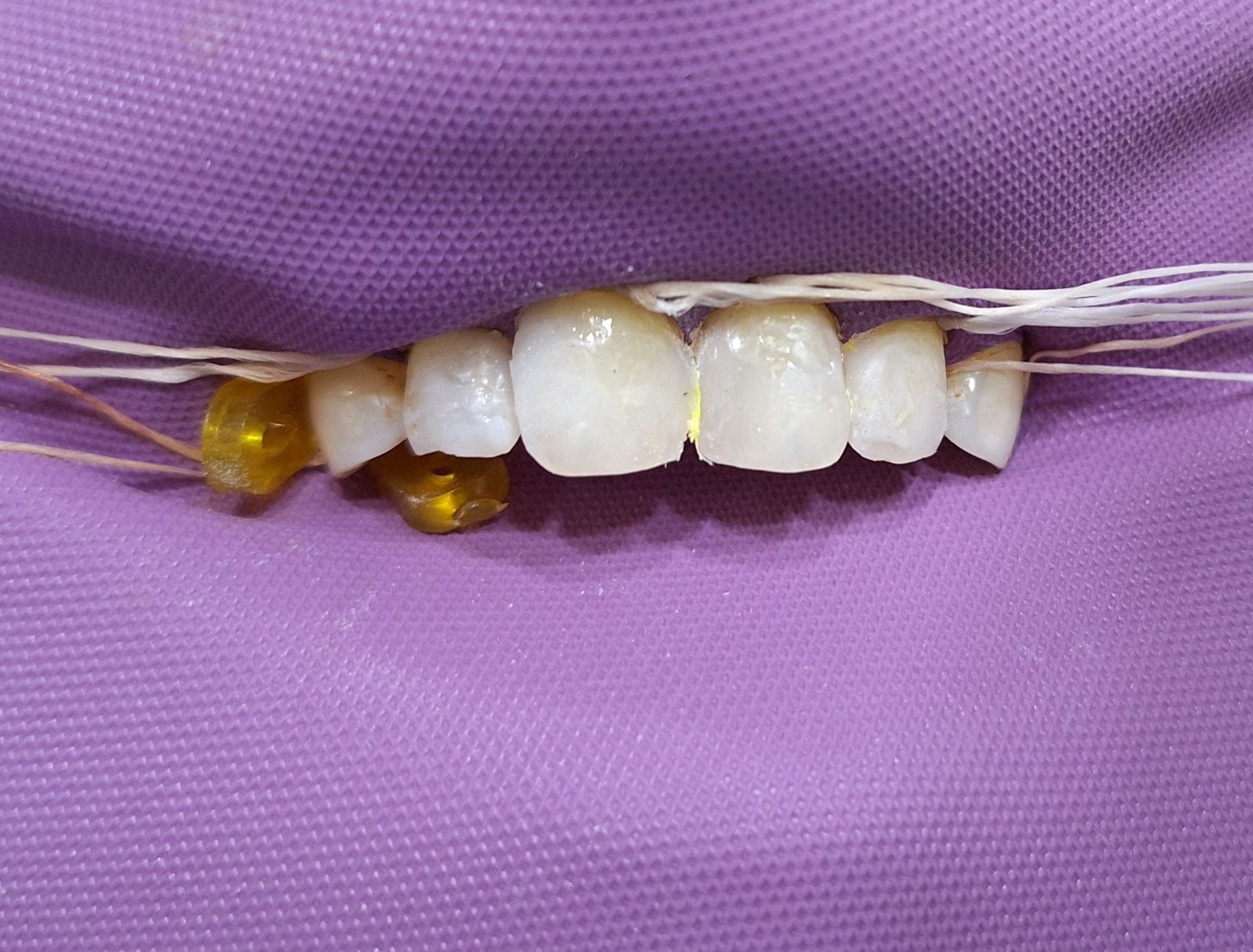
Before - Composite filling to restore decayed tooth
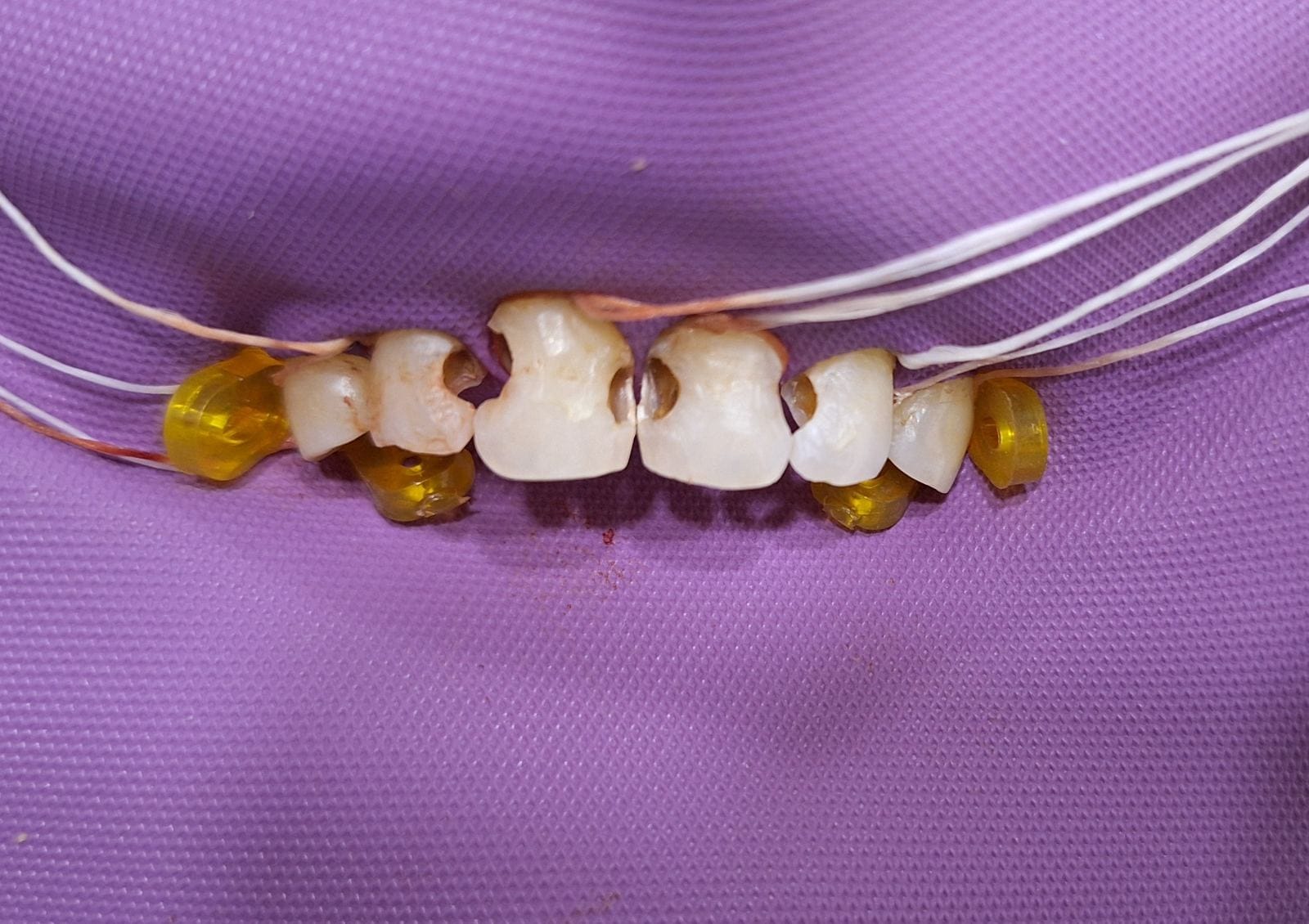
After - Composite filling to restore decayed tooth
Frequently Asked Questions
Dental Filling in Nepal — Your Questions Answered
Everything you need to know about composite fillings, glass ionomer cement, deep caries management, and dental filling costs at DentaLife Oral Concern, Kathmandu.
Understanding dental fillings
-
A dental filling is a restorative material used to repair a tooth that has been damaged by decay (cavity), a crack, a chip, or wear — restoring its normal shape, function, and appearance while preventing the damage from progressing further.
You need a filling when:
- Tooth decay (dental caries) has created a cavity — a hole in the tooth that must be cleaned out and sealed to stop bacteria from advancing deeper
- A tooth has a small crack or chip that exposes the inner dentine layer
- A previous filling has worn down, cracked, or fallen out and needs replacing
- Enamel has eroded from acid or grinding, creating sensitive exposed areas
Without a filling, bacteria continue to penetrate deeper into the tooth — progressing from enamel to dentine to the pulp, eventually requiring a root canal treatment or causing the tooth to be lost entirely. A small filling done early is always far cheaper, faster, and less uncomfortable than waiting.
Treat a cavity with a small filling before you are in pain. Pain usually means the decay has reached the pulp — at which point a root canal is needed instead of a simple filling. -
Many cavities — especially in early stages — cause no pain at all. This is why regular dental check-ups matter even when you feel fine. Signs that may suggest you need a filling include:
- Tooth sensitivity to sweet, hot, or cold food and drinks that lingers or causes a sharp twinge
- A visible dark spot or hole on the surface of a tooth
- Food getting stuck in the same spot between teeth repeatedly
- A rough or jagged edge you can feel with your tongue where enamel has broken away
- Mild toothache triggered by pressure or certain foods
- A noticeable pit or depression on the chewing surface of a back tooth
Severe or spontaneous toothache — especially pain that wakes you at night — suggests the decay has reached the pulp and a root canal may be needed rather than a simple filling. Visit DentaLife promptly for an X-ray and assessment.
-
Leaving a cavity untreated is one of the most common — and most costly — mistakes patients make. Tooth decay does not stop or reverse on its own once it has progressed past the enamel. Without a filling, the following happens progressively:
- Increased sensitivity: As decay reaches dentine, the tooth becomes increasingly sensitive to sweet, hot, and cold stimuli
- Toothache: Once decay nears the pulp, inflammatory pulpitis begins — causing persistent, sometimes severe pain
- Pulp infection: Bacteria reach the pulp, causing irreversible pulpitis or pulp necrosis — at which point root canal treatment is required
- Dental abscess: Untreated pulp infection spreads to the bone, forming a painful pus-filled abscess
- Tooth loss: If infection destroys too much supporting bone or tooth structure, the tooth must be extracted
- Spread to other teeth: Bacteria and acid from a decayed tooth can accelerate decay in neighbouring teeth
A filling at DentaLife costs NPR 1,500–5,000. A root canal plus crown costs NPR 25,000–40,000+. A dental implant to replace an extracted tooth costs significantly more. Early treatment is always the most affordable option.
Filling types & cost in Nepal
-
At DentaLife Oral Concern, Kathmandu, dental filling costs range from NPR 1,500 to NPR 5,000 per tooth. The exact cost depends on:
- The size and depth of the cavity — small, medium, or large
- The filling material used (composite tooth-coloured filling costs more than glass ionomer)
- The location of the tooth — back molars are more complex to restore than front teeth
- Whether deep caries management (pulp capping) is needed alongside the filling
For the most current prices, visit our Prices & Services page or message us on WhatsApp before your appointment.
All filling prices at DentaLife are transparent — your dentist will confirm the cost before starting any treatment, with no surprise charges. -
DentaLife offers three types of filling materials, each suited to different clinical situations:
Material Appearance Strength Best for Composite resin Tooth-coloured — matches natural shade exactly Good — bonds directly to enamel and dentine Front teeth, visible surfaces, small to medium cavities in any tooth Glass ionomer cement (GIC) Tooth-coloured — off-white, less translucent than composite Moderate — releases fluoride which helps prevent further decay Children's teeth, root surface cavities, temporary restorations, deep caries management Miracle Mix (reinforced GIC) Tooth-coloured — slightly more opaque Better than standard GIC — contains silver alloy particles for added strength Back teeth in patients at high decay risk, load-bearing areas where composite may not bond well Composite resin is the most commonly recommended filling for most patients — it matches tooth colour perfectly, bonds strongly to the tooth, and requires less removal of healthy tooth structure than older materials. Your dentist will advise the best material for your specific cavity. -
Composite resin is a tooth-coloured filling material made from a mixture of fine glass and plastic particles. It is the most widely used filling material in modern dentistry and the preferred choice at DentaLife for most cavities.
Why composite is the most popular filling:
- Invisible: The shade is matched precisely to your natural tooth colour — the filled tooth is indistinguishable from an unfilled one
- Bonds directly to tooth: Composite chemically bonds to enamel and dentine, strengthening the remaining tooth structure and requiring less healthy tooth to be removed
- Versatile: Suitable for cavities on any surface of any tooth — front or back, top or side
- Repaired easily: If a composite filling chips, it can usually be repaired chairside without replacing the entire filling
- Same-day procedure: Placed and completed in a single visit — no temporary or second appointment needed
- Mercury-free: Unlike older amalgam (silver) fillings, composite contains no mercury or metal
The filling procedure
-
A dental filling at DentaLife is completed in a single appointment and typically takes 30–60 minutes per tooth. Here is what happens:
- Step 1 — Examination & X-ray: The dentist examines the tooth and takes an X-ray if needed to assess the depth of decay and check the proximity to the pulp
- Step 2 — Local anaesthesia: A local anaesthetic is administered to numb the tooth and surrounding area, ensuring the procedure is completely pain-free
- Step 3 — Decay removal: A dental drill or air abrasion tool removes all decayed tooth material, leaving only clean, healthy tooth structure
- Step 4 — Cavity preparation: The cavity is shaped and any sharp edges smoothed to create an ideal surface for the filling to bond to
- Step 5 — Conditioning & bonding: For composite fillings, the cavity is etched with a mild acid and a bonding agent is applied — this ensures the composite adheres firmly to the tooth
- Step 6 — Filling placement: The filling material is placed in layers and shaped to match the natural contours of the tooth
- Step 7 — Curing: For composite, a blue LED curing light is used to harden each layer within seconds
- Step 8 — Bite check & polish: The filled tooth is checked against the opposing teeth — any high spots are adjusted — and the surface is polished smooth
-
With proper local anaesthesia, a dental filling is completely painless during the procedure. The numbing injection itself is the most uncomfortable part — and at DentaLife, a topical anaesthetic gel is applied to the gum first to minimise even that brief sting.
After the anaesthetic wears off:
- Mild tenderness or sensitivity around the filled tooth is normal for a few days — especially to cold, sweet, or pressure
- Sensitivity is more noticeable with deeper fillings that are closer to the pulp
- This typically settles on its own within 1–2 weeks
- If sensitivity is worsening rather than improving after 2 weeks, contact us — it may indicate the filling needs adjustment or that the decay was deeper than expected
Avoiding getting a filling because you fear pain is counterproductive — a small painless filling now prevents a much more involved procedure (root canal) that is unavoidable if decay reaches the pulp. -
A routine dental filling at DentaLife is completed in a single appointment. The time required depends on the size and location of the cavity:
- Small cavity (one surface): 30–40 minutes including anaesthesia and setting time
- Medium cavity (two surfaces): 40–60 minutes
- Large cavity (three or more surfaces): 60–90 minutes; may require more material and careful layering for composite
- Multiple fillings in one visit: Possible if the teeth are in the same quadrant — your dentist will advise at the appointment
There is no waiting period between appointments — you can eat (with precautions) and return to normal activities immediately after the procedure.
Aftercare & lifespan
-
Follow these guidelines after your filling to protect it and allow it to set properly:
- Do not eat for 30 minutes after the filling — allow the material to fully set and the anaesthetic to wear off so you do not accidentally bite your cheek or lip
- Do not chew on the filled side for 24 hours — use the opposite side of your mouth while the filling fully hardens and settles
- Chew slowly and bite lightly for the first few days — the tooth may feel slightly different until the bite settles in
- Avoid sticky foods (chewing gum, toffee, caramel) — these can dislodge a new filling before it is fully set
- Avoid very hot or very cold drinks for 24 hours — the newly restored tooth may be temporarily more sensitive
- Avoid sugary foods — sugar feeds bacteria and accelerates new decay around the filling margin
- Do not chew nuts, hard candy, or ice on the filled tooth — hard biting forces can crack or dislodge a new filling, especially in the first 24–48 hours
If the filling feels high in your bite — like one tooth is hitting harder than the others — contact DentaLife for a quick adjustment. A high bite left unchecked can cause soreness and even crack the tooth over time. -
Dental fillings are durable but do not last forever. The lifespan depends on the material, the size of the filling, and your habits:
- Composite resin filling: 5–10 years on average — can last longer with good care. May stain slightly over many years as the material ages.
- Glass ionomer cement (GIC): 3–7 years — less hard-wearing than composite but releases fluoride and is often used as a long-term temporary or in low-bite-force areas
- Miracle Mix: 5–8 years — more durable than standard GIC for back teeth
Factors that shorten filling lifespan:
- Teeth grinding (bruxism) — places excessive wear on all fillings
- Chewing hard foods regularly on the filled tooth
- Poor oral hygiene allowing new decay to develop around the filling margin
- Large filling size — larger fillings are under more stress and fail sooner than small ones
When a filling reaches the end of its lifespan, it does not always cause pain — your dentist checks filling integrity at every 6-month check-up and will advise when a replacement is needed before it becomes a problem. -
A lost filling is a dental emergency that needs prompt attention — the exposed tooth is vulnerable to pain, further decay, and fracture. Here is what to do:
- Do not panic — a lost filling is common and easily replaced
- Avoid chewing on that side — the exposed cavity is soft and sensitive; biting on it can cause pain and further damage
- Avoid very hot, cold, or sweet food on the exposed tooth — the dentine is now unprotected and will be sensitive
- Keep the area clean: Rinse gently with warm salt water to prevent food packing into the exposed cavity
- Contact DentaLife as soon as possible: Call or WhatsApp +977-9843488192 — we will assess whether the filling can simply be replaced or whether the cavity has developed new decay underneath
Do not delay replacing a lost filling. The exposed tooth will decay faster and may become painful within days to weeks — turning what was a simple re-filling into a more complex and costly procedure.
Deep caries management (DCM) & pulp capping
-
Deep Caries Management (DCM) is a specialised technique used when tooth decay has penetrated deep into the dentine — very close to (or touching) the pulp (nerve) of the tooth — but the pulp is still vital (alive) and salvageable.
In these cases, a standard filling alone is not sufficient because:
- Removing all decay aggressively risks exposing or damaging the pulp, which would then require root canal treatment
- Leaving infected dentine entirely in place risks continued pulp inflammation
DCM is the clinical approach that attempts to save the living pulp by placing a biocompatible protective material (liner) over the deepest part of the cavity — allowing the tooth to form new reparative dentine over the next 4 weeks — before the permanent filling is placed.
DCM is indicated when:
- Deep carious lesion on X-ray is within 1–2 mm of the pulp
- The tooth still responds normally to cold testing (pulp is still vital)
- There is no spontaneous pain, night pain, or swelling (no signs of irreversible pulpitis)
-
Both are types of deep caries management — the difference lies in whether the pulp is exposed or not during the procedure:
- Indirect pulp capping: Used when the deep decay is very close to the pulp but has not exposed it. All infected decay is removed except for a thin layer of affected dentine directly over the pulp (removing this last layer would risk pulp exposure). A protective liner (MTA or calcium hydroxide) is placed over this remaining dentine, then a temporary filling seals the cavity. After 4 weeks, the cavity is opened, the liner checked, and if reparative dentine has formed, a permanent composite filling is placed.
- Direct pulp capping: Used when the pulp has been accidentally exposed — for example, during cavity preparation on a deep lesion. The exposed pulp is gently cleaned with sterile saline, a biocompatible liner (MTA or calcium hydroxide) is placed directly over the exposure point, sealed with glass ionomer cement, and the tooth is reviewed after 4 weeks. If healing is confirmed, permanent filling follows.
If the pulp does not respond positively after pulp capping (pain persists, no reparative dentine forms), root canal treatment is then required. Your dentist will explain the likelihood of success for your specific case at the consultation. -
MTA (Mineral Trioxide Aggregate) is a biocompatible dental material used as a liner in direct and indirect pulp capping procedures. It is currently considered the gold standard liner material for deep caries management.
Why MTA is preferred:
- Excellent long-term sealing capabilities — prevents bacteria from reaching the pulp through the liner
- Biocompatible — does not irritate the pulp tissue; instead, it promotes the formation of a protective dentine bridge
- Higher success rate compared to other liner materials in studies on direct vital pulp exposure
- Sets in the presence of moisture — important in a biological environment like the tooth
Calcium hydroxide is a widely used alternative liner with a long track record. It stimulates reparative dentine formation effectively and has been the standard material for pulp capping for decades. It is used at DentaLife where indicated.
When a filling is not enough
-
A filling works well when the damage to the tooth is limited and enough healthy tooth structure remains to support the material. A crown is recommended instead of a filling when:
- More than half the tooth structure is destroyed by decay or fracture — the remaining walls are too thin and weak to reliably hold a filling
- A large old filling needs replacement and a new filling would not provide sufficient strength
- The tooth has completed root canal treatment and is now brittle — a crown is essential after RCT
- A visible crack runs through the tooth — a filling cannot prevent a cracked tooth from splitting further, but a crown holds it together
- The tooth is severely worn down by bruxism and needs full height and shape restoration
If you have been told you need a crown but are considering just a filling to save cost, discuss this clearly with your dentist. A filling in a tooth that needs a crown is likely to fail, fracture the tooth, and end up costing more than the crown would have. -
A cavity requires root canal treatment (RCT) instead of a filling when the dental pulp has been reached and cannot recover — this is called irreversible pulpitis or pulp necrosis.
Signs that root canal treatment is needed rather than a filling:
- Spontaneous toothache — pain that starts without any trigger and does not stop
- Pain that lingers for more than 30 seconds after a hot or cold stimulus is removed
- Severe pain when biting on the tooth
- Swelling of the gum near the tooth, or a visible pimple-like abscess
- The tooth feels numb — which can indicate the nerve has died
- Visible darkening of the tooth compared to adjacent teeth
Deep caries management (pulp capping) attempts to avoid root canal treatment by protecting a pulp that is still vital — but once the pulp is irreversibly inflamed or dead, filling or pulp capping is no longer viable and RCT is the only way to save the tooth.
See our Root Canal Treatment page for full information on laser-assisted RCT at DentaLife.
Booking & getting started
-
Booking is quick and straightforward — choose any of these options:
- WhatsApp (fastest): Message +977-9843488192 with your preferred date and time — we reply within 2 hours on working days (Sunday–Friday)
- Call us: Mobile +977-9843488192 · Landline +977-1-4163520
- Walk-in: We welcome walk-in patients — visit us at Kantipath, Jamal, Kathmandu, Sunday to Friday, 10AM–6PM
- Online: Use our online appointment form
A filling appointment typically takes 30–60 minutes and can be completed on the same day as your consultation. Walk-ins are always welcome — no prior appointment needed for routine fillings.
Think you have a cavity?
Book your filling appointment via WhatsAppDentaLife
Dental Clinic in Kathmandu





Copyright © 2026 by DentaLife Oral Concern Pvt. Ltd. – Dental Clinic in Kathmandu. +977-9843488192
Copyright © 2025 by DentaLife Oral Concern Pvt. Ltd – Dental Clinic in Kathmandu. All rights reserved.
+977-9843488192