
Teeth Whitening – Vital Teeth Bleaching
It is either the restoration of a natural tooth shade or whitening beyond the natural shade.
Teeth Whitening Cost:
Teeth whitening cost is NPR 18,000 without laser and NPR 22,000 with laser*. For recent price of teeth bleaching please Visit Our Prices / Services Page
* Dental lasers in bleaching offer precise, faster, and more comfortable treatment with minimized sensitivity and longer-lasting results.
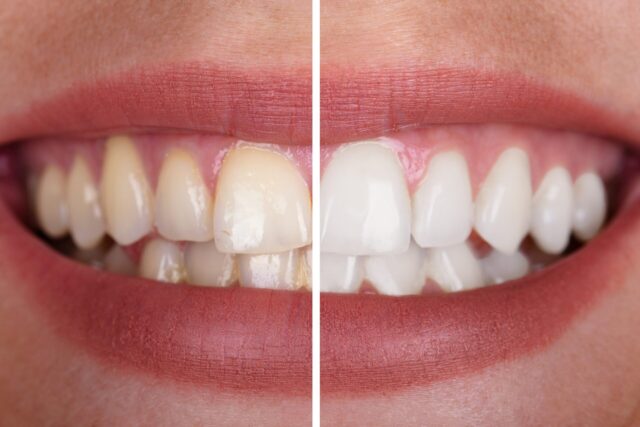
Causes of tooth stain
- Black Teas and Coffee
- Smoking Tobacco
- White and Red Wine
- Sports Drinks
- Carbonated Beverages (dark and light-colored soda )
- Strongly colored food
- Sauces (Soy, tomato, curries)
- Medications(Antibiotics such as tetracycline, doxycycline)
- Trauma
- Excessive Fluoride
Ways of Vital Teeth Bleaching / Teeth Whitening
Regular Teeth Whitening: This typically involves the application of a whitening gel containing hydrogen peroxide or carbamide peroxide to the teeth. This gel is applied either directly to the teeth or in custom-made trays that fit over the teeth. Regardless of the technique or product used, the mechanism of action of bleaching agents is based on a complex oxidation process with release of reactive oxygen species, which penetrate through the pores of enamel rods and reach the dentin, breaking down organic molecules and producing lighter and clearer shades .
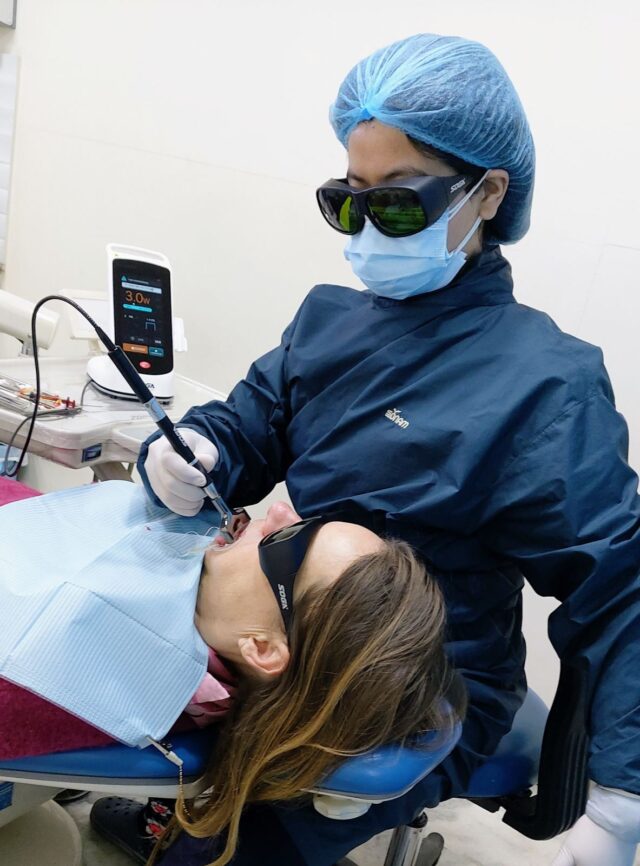
Laser Teeth Whitening: In laser teeth whitening, a similar whitening gel is applied to the teeth, but instead of relying solely on the chemical reaction for activation, a specialized laser or light is used to enhance the whitening process. The light energy activates the whitening agent in the gel, accelerating the whitening process.
Laser teeth whitening is a 20 – 30 minutes procedure that must be carried out in a dental clinic. The process is similar to conventional bleaching, except that a special light is used to speed up the oxidation of oxygen molecules.
How is it done?
- The dentist gives you protective glasses for your eyes and places a cheek retractor into your mouth.
- A protective gel (light-cured resin material) is applied to the gums to protect them from the bleaching gel.
- An intensely concentrated peroxide-based whitening gel is then applied directly onto your teeth.
- After a couple of minutes, a diode laser is then used to activate the gel.
- This whole process can be done 2-3 times until the desired shade of the tooth is obtained.
Advantages of laser teeth whitening:
- Laser teeth whitening is incredibly powerful and long lasting
- Whitening sessions are quick—each one takes around 10 – 15 minutes.
- You’ll probably see immediate results that are more dramatic than those of standard bleaching techniques.
- Medical professionals perform these procedures, so you can be sure they are safe and effective.
Can Laser teeth Whitening Damage Your Teeth?
Laser whitening cannot damage your teeth. Since tooth enamel is hard tissue, the peroxide used in laser whitening solutions does not damage it.
In summary, while both methods aim to whiten teeth by using a similar whitening agent, laser teeth whitening incorporates the use of specialized light or laser to accelerate and enhance the whitening process, potentially providing quicker and more dramatic results compared to regular teeth whitening methods. However, it’s essential to consult with a dental professional to determine which method is most suitable for your specific needs and oral health condition.
For Cost: Visit Our Prices / Services Page
Thing you may experience after bleaching
- Discomfort in the gum around the teeth due to the bleaching agent, or even improperly fitting bleaching trays.
- Tooth bleaching can make teeth temporarily sensitive- or be uncomfortable for people who already have sensitive teeth.
- When used incorrectly , home kits can also lead to burn – even temporarily bleach gums.
- It works best for people with yellow teeth and is less effective for people with brown-teeth.
Frequently Asked Questions
Teeth Whitening / Bleaching — Your Questions Answered
Everything you need to know about professional teeth whitening and laser bleaching at DentaLife, Kathmandu.
-
Teeth whitening (also called vital teeth bleaching) is a procedure that lightens the shade of your natural teeth — either restoring them to their natural colour by removing stains, or whitening them beyond their natural shade for a brighter appearance.
It works through a chemical oxidation process. A whitening gel containing hydrogen peroxide or carbamide peroxide is applied to the teeth. The active peroxide releases reactive oxygen species that penetrate through the pores of the enamel rods, reach the dentin layer, and break down organic pigment molecules — producing lighter, clearer tooth shades.
In laser whitening, a diode laser is additionally used to activate and accelerate this oxidation process, resulting in faster and more dramatic results.
-
At DentaLife Oral Concern, Kathmandu, the current prices for teeth whitening are:
- Regular teeth whitening (without laser): NPR 18,000
- Laser teeth whitening (with diode laser): NPR 22,000
The laser option costs NPR 4,000 more and delivers faster, more dramatic, and longer-lasting results with minimised sensitivity. For the most up-to-date pricing, visit our Prices & Services page or message us on WhatsApp.
Both prices are per session and all-inclusive — no hidden charges. -
Both methods use the same peroxide-based whitening gel. The key difference is how the gel is activated:
- Regular whitening relies on the chemical reaction alone — the gel is applied directly to teeth or in custom trays and works over time without additional activation.
- Laser whitening uses a specialised diode laser to activate the gel. The light energy accelerates the oxidation process — producing quicker, more dramatic, and longer-lasting results with less sensitivity compared to regular whitening.
Laser whitening advantages: Each round takes only 10–15 minutes, results are more dramatic and immediate, sensitivity is minimised, and results last longer. The procedure is performed entirely by medical professionals in the clinic. -
Here is what to expect for each method:
- Laser teeth whitening: Each individual round takes 10–15 minutes. The full procedure involves 2–3 rounds until the desired shade is reached — so the total in-chair time is approximately 30–45 minutes.
- Regular teeth whitening: A single in-clinic session is typically 45–60 minutes depending on the technique used.
There is no downtime — you can return to normal activities immediately after the procedure.
-
No — laser whitening cannot damage your teeth. Tooth enamel is a hard, mineralised tissue. The peroxide concentration used in professional whitening solutions does not chemically alter or damage enamel structure.
The oxidation process only affects the organic pigment molecules embedded within the enamel and dentin — leaving the hard tissue itself intact. This is why professional whitening performed by a dentist is considered safe, provided it is done correctly and within the recommended concentrations.
Home whitening kits bought online or from shops carry more risk — they are often used incorrectly and at uncontrolled concentrations, which can cause gum burns and sensitivity. Professional in-clinic whitening at DentaLife is always supervised by our dentists. -
Results vary depending on the method and your lifestyle habits:
- Laser whitening: Results typically last 6 months plus with good maintenance
- Regular whitening: Results generally last slightly less, depending on diet and oral hygiene
The single biggest factor that reduces whitening longevity is diet. The following cause rapid re-staining and should be minimised after whitening:
- Tea and coffee (especially black tea)
- Red wine
- Smoking and tobacco use
- Strongly coloured sauces (soy, tomato, curry)
- Carbonated dark beverages
Brush teeth within 30 minutes of consuming staining food or drinks, and schedule a dental scaling every 6 months to maintain your whitened shade. -
Tooth discolouration has two main categories — extrinsic (surface) staining and intrinsic (internal) staining. The most common causes include:
- Beverages: Black tea, coffee, red and white wine, sports drinks, dark carbonated drinks
- Food: Strongly coloured sauces (soy, tomato, curry), berries, and pigmented foods
- Tobacco: Cigarette smoking and smokeless tobacco
- Medications: Antibiotics such as tetracycline or doxycycline (taken during tooth development) cause deep intrinsic staining that is harder to treat
- Trauma: Injury to a tooth can cause internal bleeding and grey/brown discolouration
- Excess fluoride: During early childhood, excessive fluoride intake can cause fluorosis — white spots or brown mottling on enamel
- Ageing: Enamel naturally thins over time, revealing more of the yellowish dentin underneath
Whitening works best on yellow extrinsic stains. Brown-toned teeth respond less predictably, and intrinsic staining from tetracycline or trauma may require alternative treatments such as veneers.
-
Teeth whitening works best for yellow extrinsic staining — the most common type, caused by tea, coffee, tobacco, and food. Results are typically dramatic and immediate for this group.
Whitening is less effective for:
- Brown-toned teeth — may show improvement but results are less predictable
- Tetracycline staining — deep intrinsic antibiotic stains may require multiple sessions or alternative treatments like veneers or crowns
- Fluorosis — white spots or mottled enamel from excess fluoride — professional assessment needed
- Grey teeth from trauma — internal discolouration may need internal bleaching or a crown
- Dental restorations — whitening gel does not change the colour of crowns, veneers, or composite fillings
A consultation with our dentist before booking will confirm whether whitening is the right treatment for your specific staining type.
-
In most cases, yes — but sensitivity is the most common side effect of whitening, even in people who do not normally have sensitive teeth.
What to know:
- Temporary tooth sensitivity after whitening is normal and typically resolves within 24–48 hours
- Sensitivity is caused by the peroxide temporarily increasing the permeability of dentin tubules
- Laser whitening actually causes less sensitivity than regular whitening, because the laser allows a shorter gel contact time for equivalent or better results
- Our dentists assess your teeth before the procedure and can adjust gel concentration or session length to minimise sensitivity for you specifically
If you already have very sensitive teeth or exposed root surfaces, let our dentist know before starting. A desensitising agent can be applied before or after the procedure to reduce discomfort. -
Here is the step-by-step process for laser whitening at DentaLife:
- Step 1: Protective glasses are given to shield your eyes from the laser light. A cheek retractor is placed to keep lips and cheeks away from the gel.
- Step 2: A protective light-cured resin material is applied to the gums to shield them from the bleaching gel.
- Step 3: An intensely concentrated peroxide-based whitening gel is applied directly onto the surfaces of your teeth.
- Step 4: A diode laser is directed at the gel to activate and accelerate the whitening reaction — each round takes 10–15 minutes.
- Step 5: Steps 3 and 4 are repeated 2–3 times until the desired shade is achieved. Your dentist compares shades before and after each round.
The full procedure takes approximately 30–45 minutes. You can eat, drink, and return to normal activities afterward, with only a few dietary precautions for the first 24 hours.
-
The first 24–48 hours after whitening are the most important for protecting your results, as the enamel pores are temporarily more open and more susceptible to staining:
- Avoid tea, coffee, red wine, and dark-coloured drinks for at least 24 hours
- Avoid strongly coloured foods — curries, soy sauce, tomato sauce, berries
- Do not smoke for at least 24 hours after whitening
- Avoid very hot or very cold food and drinks if sensitivity is present
- Stick to white or light-coloured foods — chicken, rice, pasta, milk, white cheese — for the first day
After the first 48 hours, resume normal diet — just minimise the staining food and drink habits listed above for the long term to maintain your results. -
Yes — professional in-clinic whitening is significantly safer and more effective than over-the-counter home kits. Here is why:
- Concentration: Professional whitening gels use higher concentrations of peroxide, delivering more dramatic results in a single session
- Safety: Home kits used incorrectly can cause gum burns and temporary bleaching of soft tissue — our dentists apply protective resin to gums before every procedure
- Supervision: A dentist assesses your suitability, monitors each round, and can stop or adjust if needed
- Custom shade control: The dentist compares your shade before and after each round to achieve the exact result you want — not a generic outcome
- No enamel risk: Professionally supervised whitening at correct concentrations does not damage enamel
Home kits are fine for very minor maintenance between professional sessions — but for actual whitening results, professional treatment is always the more reliable and safer choice. -
Whitening gel works only on natural tooth enamel — it does not change the colour of dental restorations such as composite fillings, porcelain crowns, or veneers. This means:
- If you have visible fillings or crowns on front teeth, whitening your natural teeth may create a colour mismatch between the whitened teeth and the unchanged restorations
- In such cases, your dentist will discuss whether the restorations should be replaced after whitening to match the new shade
- For patients with multiple restorations in the smile zone, veneers or crowns may be a more comprehensive solution for a uniform bright smile
A pre-whitening consultation with our dentist will identify any restorations and advise the best approach for your specific smile.
-
Yes — scaling before whitening is strongly recommended and is standard practice at DentaLife. Here is why it matters:
- Whitening gel works on clean tooth enamel. If calculus or plaque deposits are present, they physically block the gel from reaching the tooth surface — producing uneven or reduced results
- Scaling removes surface stains first, so the whitening gel can work on the actual enamel shade rather than stain
- Clean teeth allow a more accurate shade assessment before whitening
If your teeth have not been professionally cleaned recently, our team will recommend a scaling and polishing session first. This can often be done on the same day or at a separate visit just before whitening.
Need scaling first? See our Teeth Scaling page — scaling and polishing from NPR 2,500. -
Booking is quick and easy — choose any of these options:
- WhatsApp (fastest): Message +977-9843488192 with your preferred date and time — we reply within 2 hours on working days (Sunday–Friday)
- Call us: Mobile +977-9843488192 · Landline +977-1-4163520
- Walk-in: Visit us at Kantipath, Jamal, Kathmandu — Sunday to Friday, 10AM–6PM
- Online: Use our online appointment form
Weekend slots fill quickly — if you are planning whitening before a special occasion, we recommend booking at least a week in advance.
Ready for a brighter smile?
Send us your preferred date & time on WhatsAppDentaLife
Dental Clinic in Kathmandu





Copyright © 2026 by DentaLife Oral Concern Pvt. Ltd. – Dental Clinic in Kathmandu. +977-9843488192
Copyright © 2025 by DentaLife Oral Concern Pvt. Ltd – Dental Clinic in Kathmandu. All rights reserved.
+977-9843488192