
Impacted Wisdom Teeth and their Effect on the Natural Adjacent Tooth
Impacted Wisdom Teeth are the third molars at the back of the mouth that lack enough space to grow naturally. In such case, wisdom tooth extraction is needed. For extraction, Oral & maxillofacial surgeon is specialist dentist who can safely remove the teeth using their expertise. Please call us for appointments with our dentist. We accept walk-ins, call or online appointments at anytime.
Landline: +977-1-4163520 | Mobile: +977-9843488192
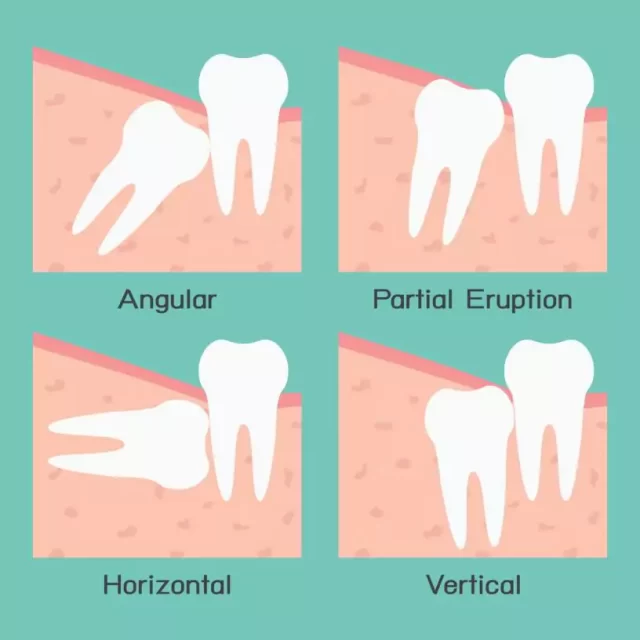
How the teeth gets Impacted?
- Wisdom teeth likely to become impacted because of a mismatch between the size of the teeth and the size of the jaw.
- If this happens, pain can develop with the onset of inflammation or infection or damage to the adjacent teeth.
Tooth Extraction Cost
Price for tooth extraction ranges from NPR 2000-5000 for simple cases to NPR 6000 – 18,000 for complicated or impacted cases. For more details of tooth extraction cost please Visit Our Prices / Services Page
Different Types Of Impaction
- Mesial/Distal Impaction
- Vertical Impaction
- Horizontal Impaction
- Bony Impaction
- Soft tissue Impaction
- Partial Impaction
What happens if you DON’T REMOVE Impacted Wisdom Teeth
If trapped in the gums, impacted wisdom teeth may lead to various dental problems such as infection, pain, swelling or misalignment of the other teeth.
- Gum infection and Pain
- Extensive Tooth Decay: Impacted teeth causes collection of saliva, food debris and bacteria around it . This could cause decay on the wisdom tooth or on the adjacent teeth .
- Damage to the teeth: Impacted teeth commonly affects the adjacent teeth leading to an irregular alignment of teeth , toothache and sensitivity. The inflammation of the surrounding tissues caused by the dental plaque, together with the pressure of the wisdom tooth pushing on the adjacent tooth in front, this causes the root of the adjacent tooth to resorb
- Abscesses
- Cysts
After Extraction of Wisdom Tooth
What To Do?
- Bite on the gauze for about 30 mins .
- Remove the gauze after 30 mins and take something extremely cold, like an Ice-cream.
- Take your painkiller right away before the effect of anesthesia goes off.
- Take cold and soft diet for 24 hrs.
- To prevent Swelling ;apply an ice pack or a cold towel to your cheek . Do this for at least 20 mins .Repeat the same every 1 hour for first 24 hours.
- After 24 hour, rinse at least 3-4 times a day with warm salt water for 1 week.
- Take your medication as prescribed by the doctor.
- If suturing has been done it should be removed after 1 week.
What NOT To Do?
- Do not for spit or rinse for next 24 hours after the removal of tooth ,it may lead to bleeding .
- Avoid hot, spicy and hard food or drink for 24 hours.
- Avoid smoking and alcohol consumption for at least 48 hours.
- Do not drink juice or any liquid through Straw.
- After tooth removal, cheeks will be numb for few hours so do not bite on your cheeks and lips.
- Avoid exercising for 12-24 hours and heavy lifting for 2-3 days.
- Brushing should not be done on the day of tooth removal as it might remove the blood clot. Continue regular brushing gently from the next day.
Frequently Asked Questions
Wisdom Teeth Removal in Nepal — Your Questions Answered
Everything you need to know about impacted wisdom teeth, extraction, costs, and recovery at DentaLife Oral Concern, Kathmandu.
Understanding wisdom teeth
-
Wisdom teeth — also called third molars — are the last four teeth to erupt, one in each corner of the mouth, typically appearing between the ages of 17 and 25. They are called wisdom teeth because they emerge at an age when a person is considered to be maturing into adulthood.
Wisdom teeth cause problems primarily because of a size mismatch between the teeth and the jaw. Modern human jaws are smaller than those of our ancestors — due to dietary changes over generations — yet we still develop the same number of teeth. When there is not enough space at the back of the arch, the wisdom tooth cannot erupt normally and becomes impacted — trapped fully or partially inside the jawbone or gum tissue.
Not all wisdom teeth cause problems. Some erupt fully and correctly without any issues. Others remain below the gum but cause no symptoms. Removal is only needed when the wisdom tooth is causing — or is likely to cause — damage to the adjacent teeth, gum, or bone.
-
Wisdom teeth can be impacted in several different positions and depths — each affecting the complexity of removal. The main types are:
- Mesial impaction: The tooth is angled forward toward the front of the mouth — the most common type. The wisdom tooth leans into the second molar in front of it, putting pressure on its root.
- Distal impaction: The tooth is angled backward toward the throat — less common. Often less problematic but may still need removal if causing decay or gum issues.
- Vertical impaction: The tooth is positioned correctly (vertically) but does not have enough space to erupt fully through the gum. May erupt partially or remain fully submerged.
- Horizontal impaction: The tooth lies completely on its side — at 90 degrees — pointing directly into the root of the adjacent molar. Often the most complex to remove.
- Bony impaction: The tooth is partially or completely embedded in the jawbone — requiring surgical removal including removal of overlying bone.
- Soft tissue impaction: The tooth has penetrated the bone but has not emerged through the gum — the overlying gum tissue covers it and requires surgical incision for removal.
- Partial impaction: The tooth has partially erupted through the gum — leaving a flap of gum tissue over part of the tooth that traps food and bacteria, causing recurring infection.
An OPG (panoramic X-ray) at DentaLife shows the position, angle, and depth of all four wisdom teeth clearly — allowing our oral surgeon to plan the safest and most efficient extraction approach before touching the tooth. -
This is one of the most serious — and most commonly overlooked — consequences of leaving an impacted wisdom tooth untreated. A mesially or horizontally impacted wisdom tooth pushes directly into the root of the second molar (the tooth directly in front of it), causing:
- External root resorption: The pressure of the impacted tooth and the associated inflammation causes the root of the adjacent second molar to dissolve — a process called external root resorption. This damage is often irreversible and can eventually cause the loss of the healthy second molar.
- Decay on the adjacent tooth: The narrow gap between an impacted wisdom tooth and the second molar is impossible to clean — food and bacteria accumulate, causing decay on the side of the second molar that is extremely difficult to detect and treat early.
- Bone loss: Chronic low-grade infection and inflammation around an impacted wisdom tooth causes the surrounding jawbone to resorb — weakening the bone support for the adjacent tooth.
- Pain and sensitivity: Pressure on the adjacent root causes toothache, sensitivity, and referred pain that can be difficult to localise without an X-ray.
The damage to the adjacent second molar from an impacted wisdom tooth often happens silently — with no pain — until significant root resorption or decay has already occurred. This is why an OPG X-ray is recommended even when you feel no symptoms.
Do I need my wisdom teeth removed?
-
See a dentist promptly if you experience any of the following around the back of your mouth:
- Pain or aching at the back of the jaw — may be constant or come and go
- Swollen, red, or tender gum behind the last tooth on either side
- Difficulty opening the mouth fully (trismus) — a sign of spreading infection around the jaw muscles
- Swelling of the cheek or jaw on one side — indicates abscess formation
- Bad taste or smell coming from the back of the mouth — infection or food trapping under a gum flap
- Sensitivity or pain in the tooth in front of the wisdom tooth — may indicate root damage or decay from the impacted wisdom tooth
- Headache radiating from the jaw — can be referred pain from an impacted tooth
- No symptoms — impacted wisdom teeth discovered on routine X-ray that are positioned to damage adjacent teeth should be removed even without symptoms
Symptoms come and go — a wisdom tooth that felt fine for months can become acutely infected within days. Do not wait for the pain to become severe before seeking assessment. -
Leaving a problematic impacted wisdom tooth untreated leads to a progressive chain of complications:
- Pericoronitis: Recurring infection under the gum flap overlying a partially erupted wisdom tooth — causing pain, swelling, trismus (difficulty opening mouth), and bad breath. Episodes typically worsen over time.
- Decay: The inaccessible gap between an impacted wisdom tooth and the adjacent molar traps food and bacteria, causing decay that can destroy both teeth.
- Root resorption of adjacent tooth: The pressure and inflammation silently dissolves the root of the second molar — potentially causing the loss of an otherwise healthy tooth.
- Abscess: Untreated infection spreads to the bone and surrounding soft tissues, forming a painful abscess. In severe cases this can involve the facial spaces — a potentially life-threatening emergency.
- Cyst formation: The follicle (sac) around an unerupted wisdom tooth can expand into a dental cyst over years — destroying significant amounts of jawbone and potentially requiring major surgery if left until large.
- Crowding of other teeth: The pressure from erupting wisdom teeth may contribute to crowding of the front teeth over time — though this is debated and not the primary reason for removal.
Wisdom tooth removal becomes more complex and carries higher risk as you get older. The roots become longer and more curved with age, the bone becomes denser, and healing is slower. Early removal — before problems develop — is always easier, faster, and lower-risk than emergency removal in acute infection. -
Pericoronitis is an infection of the gum tissue that partially covers an erupting or impacted wisdom tooth. It is the most common acute complication of wisdom teeth and is caused by bacteria trapped in the space between the wisdom tooth and the overlying gum flap (operculum).
Symptoms of pericoronitis:
- Pain and throbbing at the back of the jaw
- Swollen, red gum tissue behind the last tooth
- Difficulty and pain when biting down — especially if the upper wisdom tooth bites on the swollen lower gum
- Difficulty fully opening the mouth (trismus) in more severe cases
- Bad taste or discharge from the area
- Facial swelling and fever in severe spreading infection
Treatment:
- Acute phase: Irrigation and debridement of the infected flap, antibiotics if infection is spreading, and pain management
- Definitive treatment: Extraction of the causative wisdom tooth once the acute infection has subsided — or operculectomy (removal of the gum flap) in rare cases where the wisdom tooth has a good long-term prognosis
Pericoronitis almost always recurs until the wisdom tooth is removed — antibiotics alone are a temporary measure.
Cost & procedure
-
At DentaLife Oral Concern, Kathmandu, wisdom tooth extraction costs are:
- Simple extraction (fully erupted, easily accessible tooth): NPR 2,000–5,000
- Surgical or impacted extraction (partially or fully impacted, requiring incision, bone removal, or sectioning of the tooth): NPR 6,000–18,000
The cost varies depending on:
- The degree and type of impaction (soft tissue, partial, full bony)
- The angulation of the tooth (vertical, mesial, horizontal)
- The depth of the tooth in the bone
- The anatomy of the roots (number, curvature, proximity to the inferior alveolar nerve)
- Whether the tooth needs to be sectioned (cut into pieces) for safe removal
Your dentist will take an X-ray and give you an exact quote before beginning the procedure. For detailed pricing, visit our Prices & Services page.
All four wisdom teeth can sometimes be removed in a single appointment — ask our surgeon whether this is suitable for your case. -
Here is what to expect during a wisdom tooth extraction at DentaLife:
- Step 1 — X-ray assessment: An OPG (panoramic X-ray) is taken to assess the position, angulation, root anatomy, and proximity to vital structures before any extraction is planned
- Step 2 — Local anaesthesia: The area around the wisdom tooth is numbed with local anaesthetic injections. You will feel pressure but no sharp pain during the procedure.
- Step 3 — Incision (if surgical): For impacted teeth, a small incision is made in the gum to expose the underlying bone and tooth
- Step 4 — Bone removal (if needed): A small amount of bone overlying the impacted tooth is carefully removed to access the tooth
- Step 5 — Tooth sectioning (if needed): For horizontally or deeply impacted teeth, the tooth is divided into sections using a drill to make removal easier and minimise trauma to surrounding bone
- Step 6 — Extraction: The tooth (or sections) is gently elevated and removed from the socket using specialised surgical instruments
- Step 7 — Socket cleaning: The socket is thoroughly irrigated and inspected to ensure no tooth fragments remain
- Step 8 — Suturing: The gum is repositioned and sutured closed — sutures are usually removed 7 days later
- Step 9 — Post-operative instructions: A gauze pack is placed and you are given detailed written aftercare instructions and prescribed medication
-
Wisdom tooth removal is performed under local anaesthesia, making the procedure itself painless. The area is fully numbed before any work begins — you will feel pressure, pushing, and movement as the tooth is loosened and removed, but no sharp pain.
What many patients worry about — and the reality:
- The injection: A small sting lasting a few seconds as the anaesthetic is administered — a topical gel is applied first to minimise even this
- During the extraction: Pressure and vibration — not pain. If you feel anything sharp, tell your dentist immediately so additional anaesthetic can be given
- Sounds: Surgical wisdom tooth removal involves drilling sounds — this can feel alarming but causes no pain
- After the anaesthetic wears off: Moderate aching and soreness for 2–4 days is normal and expected — managed well with the prescribed painkillers and anti-inflammatory medication
Taking your prescribed painkiller before the anaesthetic wears off — while you are still numb — is the most effective way to manage post-extraction discomfort. Do not wait until the pain starts. -
Wisdom tooth extractions at DentaLife — particularly surgical and impacted cases — are performed by our Oral & Maxillofacial Surgeon. An oral and maxillofacial surgeon is a dental specialist with postgraduate surgical training in procedures involving the mouth, jaws, face, and neck.
Having an oral and maxillofacial surgeon perform impacted wisdom tooth removal is important because:
- Impacted wisdom tooth roots can be in close proximity to the inferior alveolar nerve (the nerve supplying sensation to the lower lip, chin, and teeth) — precise surgical technique is essential to avoid nerve injury
- Complex impactions — horizontal, deeply bony, or teeth with curved roots — require surgical experience and judgement to remove safely with minimal bone removal
- Complications such as excessive bleeding, adjacent tooth damage, or socket infection are managed far more effectively by a surgeon with specialist training
Simple fully-erupted extractions may be performed by our general dentists.
Aftercare & recovery
-
Following the post-extraction instructions carefully is essential — it directly determines how quickly and smoothly you recover:
✓ DO this ✗ Do NOT do this Bite firmly on the gauze pack for 30 minutes to control bleeding Do not spit or rinse for the first 24 hours — this dislodges the blood clot Take your painkiller immediately — before the anaesthetic wears off Do not drink through a straw for at least 24 hours — suction dislodges the clot Apply an ice pack to the cheek for 20 minutes every hour for the first 24 hours to reduce swelling Do not smoke or use tobacco for at least 48 hours — nicotine impairs healing and causes dry socket Eat cold, soft foods for the first 24 hours — ice cream is ideal Do not consume hot, spicy, or hard food or drinks for 24 hours After 24 hours, rinse gently with warm salt water 3–4 times daily for 1 week Do not exercise or lift heavy objects for 12–24 hours (2–3 days for strenuous activity) Take all prescribed medications as directed, even if you feel fine Do not brush the extraction site on day 1 — resume gentle brushing from day 2 onwards Return for suture removal after 7 days if sutures were placed Do not consume alcohol for at least 48 hours — it interferes with healing and medications -
Recovery time varies depending on the complexity of the extraction:
- Simple extraction: Most patients feel comfortable within 2–3 days and return to normal activities within 2–3 days
- Surgical impacted extraction: 4–7 days of significant swelling and discomfort is normal. Most people return to work or normal activity within 3–5 days. Full soft tissue healing takes 2–3 weeks. Complete bone healing takes 3–6 months.
What to expect day by day after surgical removal:
- Day 1: Bleeding (controlled with gauze), numbness wearing off, begin painkillers. Eat cold soft food. No rinsing or spitting.
- Days 2–3: Swelling peaks on day 2–3 — this is normal and expected. Apply ice for the first 24 hours then switch to warm compresses. Continue painkillers and antibiotics as prescribed.
- Days 4–7: Swelling starts to subside. Pain reduces significantly. Soft diet continues. Begin warm salt water rinses.
- Day 7: Suture removal appointment. Most patients feel close to normal by this stage.
- Week 2 onwards: Gum tissue heals over the socket. Diet gradually returns to normal.
-
Dry socket (alveolar osteitis) is the most common complication after tooth extraction — occurring in approximately 2–5% of routine extractions and up to 30% of impacted lower wisdom tooth removals.
It happens when the blood clot that normally forms in the socket after extraction is dislodged or fails to form — leaving the underlying bone and nerves directly exposed to air, food, and bacteria. This causes:
- Severe, throbbing pain starting 3–5 days after extraction — often worse than the original toothache
- Pain radiating to the ear, temple, or neck on the same side
- An unpleasant taste or smell from the socket
- Visible empty socket — you can see or probe bare bone rather than a dark blood clot
To prevent dry socket:
- Do not spit, rinse, or use a straw for 24 hours after extraction
- Do not smoke for at least 48–72 hours — smoking is the biggest risk factor for dry socket
- Avoid alcohol for 48 hours
- Eat soft, cool foods — avoid hard, crunchy, or hot food that can disturb the socket
- Follow all post-operative instructions given by your dentist precisely
If you suspect dry socket — pain worsening rather than improving after day 3 — contact DentaLife immediately. Treatment involves gentle irrigation of the socket and placement of a medicated dressing that provides rapid pain relief. Do not delay as dry socket does not resolve on its own. -
Yes — swelling and bruising after surgical wisdom tooth removal are completely normal and expected. The body's inflammatory response to surgery causes fluid accumulation in the surrounding tissues.
- Swelling typically peaks on days 2–3 after surgery before gradually reducing. For lower wisdom teeth, swelling of the cheek on that side is very common.
- Bruising (a yellowish or purplish discolouration on the cheek or neck) may appear 2–3 days after surgery as blood disperses through the tissue layers. This is harmless and resolves within 1–2 weeks.
- Trismus (difficulty fully opening the mouth) due to muscle swelling and inflammation around the surgical site is common for 3–7 days.
Managing swelling effectively:
- Apply an ice pack wrapped in a cloth to the cheek for 20 minutes on, 20 minutes off for the first 24 hours — this reduces swelling significantly
- Sleep with your head elevated (use an extra pillow) for the first 2–3 nights to help reduce swelling
- After 24 hours, switch from ice to gentle warm compress to help disperse swelling faster
- Take prescribed anti-inflammatory medication as directed
Swelling that continues to worsen after day 3, or is accompanied by fever, difficulty swallowing, or spreading redness — contact DentaLife immediately as these may indicate a developing infection.
Complications & special situations
-
Wisdom tooth extraction is a routine surgical procedure with a very high safety record. However, like any surgical procedure, it carries a small risk of complications. Your DentaLife surgeon will discuss these specific to your case before treatment:
- Dry socket (alveolar osteitis): The most common complication — occurs in 2–30% of cases. Painful but treatable with a medicated dressing.
- Infection: Bacterial infection of the extraction socket — managed with antibiotics and irrigation. Risk is reduced by following post-operative instructions.
- Nerve injury: The inferior alveolar nerve (lower lip/chin sensation) or lingual nerve (tongue sensation) may rarely be bruised or damaged during lower wisdom tooth surgery — causing numbness or altered sensation. Most cases resolve fully within weeks to months; permanent nerve damage is rare.
- Excessive bleeding: Controlled with pressure, haemostatic agents, or suturing. Patients on blood thinners or with clotting disorders require special management — inform your dentist.
- Adjacent tooth damage: Very rarely, instruments may nick or stress the adjacent second molar — careful surgical technique minimises this risk.
- Jaw fracture: Extremely rare — only in cases of very deep impactions in significantly weakened bone.
- Sinus communication: For upper wisdom teeth only — the roots may be close to the maxillary sinus, and removal can occasionally create a temporary opening between the mouth and sinus.
The risks of leaving a problematic impacted wisdom tooth in place far outweigh the risks of surgical removal by a trained oral surgeon. Discuss any concerns with your DentaLife surgeon before your procedure. -
In many cases, yes — removing all four wisdom teeth in a single appointment is possible and is often the most practical approach for the patient. Advantages of same-day removal of all four:
- Only one episode of anaesthesia, recovery, and time off work
- More cost-effective than separate appointments
- All potential future problems are resolved in one procedure
However, same-day removal of all four is not always recommended when:
- All four teeth are deeply impacted and complex — the procedure would be excessively long in one sitting
- The patient has significant medical conditions requiring careful monitoring
- Both sides of the jaw are treated simultaneously, making eating and recovery significantly more difficult for a few days
Your DentaLife surgeon will assess the complexity of each wisdom tooth and advise whether same-day removal of all four is appropriate for your specific case.
-
Antibiotics can temporarily reduce the symptoms of an infected wisdom tooth — reducing pain and swelling — but they cannot cure the underlying cause. Once the antibiotics are finished, the infection will return.
Wisdom tooth infections recur because the anatomical cause — food and bacteria trapped under a gum flap, or a decaying impacted tooth — remains unchanged. Antibiotics suppress the bacterial load temporarily but cannot eliminate it permanently without removing the source.
The only definitive treatments are:
- Extraction of the wisdom tooth — removes the source of infection permanently
- Operculectomy — removal of the overlying gum flap in selected cases where the wisdom tooth is well positioned and worth retaining
Never rely on antibiotics as a long-term solution for an infected wisdom tooth. Each episode of infection is potentially more severe than the last — and attempting extraction during active infection can be more complex and risky than doing it electively when you are well.
Booking & getting started
-
Booking is easy — choose any of these options:
- WhatsApp (fastest): Message +977-9843488192 with your preferred date and time — we reply within 2 hours on working days (Sunday–Friday)
- Call us: Mobile +977-9843488192 · Landline +977-1-4163520
- Walk-in: Walk-ins are welcome at Kantipath, Jamal, Kathmandu — Sunday to Friday, 10AM–6PM
- Online: Use our online appointment form
If you have facial swelling, difficulty opening your mouth, or swallowing difficulty — these are signs of a spreading dental infection and require immediate attention. Call us or come in directly — do not wait for an online booking confirmation in an emergency.
Wisdom tooth pain or swelling?
Book your appointment via WhatsApp — we reply within 2 hoursDentaLife
Dental Clinic in Kathmandu





Copyright © 2026 by DentaLife Oral Concern Pvt. Ltd. – Dental Clinic in Kathmandu. +977-9843488192
Copyright © 2025 by DentaLife Oral Concern Pvt. Ltd – Dental Clinic in Kathmandu. All rights reserved.
+977-9843488192