
Root Canal Treatment in Nepal
Root Canal Treatment in Nepal (RCT)
Root Canal Treatment in Nepal is generally done without laser. At DentaLife, our RCT Specialist performs Root Canal Treatments using advanced laser technology, which ensures better disinfection, faster healing, and improved overall results. With their expertise and the latest equipment, our team provides safe and effective RCT at the same cost as traditional treatment. Schedule a consultation with our RCT specialist to determine if you need RCT and get full details on pricing and procedure. We welcome walk-ins, phone calls, and online bookings.
Landline: +977-1-4163520 | Mobile: +977-9843488192
WHAT IS ROOT CANAL TREATMENT (RCT)?
A root canal treatment is a procedure to repair and save a tooth in which the pulp has been exposed due to decay or trauma. RCT is possible if the root and the supporting tissues of the tooth are in good condition. During a root canal procedure, the infected nerve and pulp are removed, then the root canal is cleaned, disinfected (with laser assistance), and sealed. Later, a crown is placed to support and protect the tooth.
How does the tooth becomes infected/damaged?
- Deep tooth decay
- Severe attrition
- Cracks in the tooth
- Trauma to the tooth
- Dislodged large fillings
Root Canal Treatment Cost
Root Canal Treatment (RCT) cost ranges from NPR 10,000 to NPR 16,000, depending on the location and complexity of the tooth. Laser-assisted RCT is done at no additional cost. For updated prices, please visit our Prices / Services Page
What if I don’t do Root Canal Treatment?
- Risk of serious infection that can spread to other teeth and body parts
- Formation of dental abscess (pus)
- Permanent loss of tooth
How many visits required for RCT?
Laser-assisted RCT can sometimes be completed in fewer visits due to faster and more effective disinfection:
- Patient with an infected pulp and presence of pus requires more dental visits. Usually, To complete RCT it takes 3-4 visits in the interval of 4-5 days.
- In selected cases with no pus or severe pain, single-visit RCT with laser may be possible.
Re RCT
Often referred as Retreatment of Root canals, is a dental procedure performed when a previously root canal–treated tooth becomes infected or fails to heal properly.
Why Is Retreatment Needed?
- Incomplete cleaning during the first RCT
New decay - Missed canals or extra roots not treated
- Reinfection due to a broken crown, leaking filling, or trauma
- Delayed crown placement after original RCT
Note: Re RCT Treatment requires more visits than regular RCT. Success Rate is slightly lower but still effective.
Alternatives If Retreatment Fails:
- Apicoectomy (surgical endodontic treatment)
- Extraction and replacement with implant or bridge
Single Visit RCT
Single Visit RCT (Root Canal Treatment) refers to completing the entire root canal procedure in one appointment, rather than multiple visits.
When Is Single Visit RCT Done?
- Vital pulp cases (irreversible pulpitis with no infection)
- Teeth with straight canals and easy access
- No signs of swelling or acute infection
- Patient availability or preference
Advantages:
- Saves time (one appointment)
- Reduced number of anesthetic injections
- No risk of inter-appointment contamination
- Higher patient compliance
When Not to Do It:
- Acute infection/swelling (abscess)
- Complex root canal anatomy
- Retreatment cases
- Large periapical lesions
Is RCT a painful / painless procedure?
- RCT is a painless procedure. Once, the root canal is opened, the pain is relieved.
- Pain might occur during the root canal procedure but can be relieved by an analgesics of Local Anesthesia (LA).
- Laser use further reduces discomfort and speeds up healing.
What to be done/not to be done after RCT?
As RCT treated tooth will not have the efficiency and force as that of the natural tooth, you need to be really careful.
| Things not to be done | Things to be done |
| – Not eat or chew any hard food from the RCT treated tooth as biting/chewing on hard food will have tendency to fracture the filling/tooth itself. | – Crown must be placed in the RCT treated tooth in order to withstand the biting force and prevents the fracture of the filled tooth. |
What can be alternatives to be a Root Canal Treatment in Nepal?
- Preventing your original tooth is very important. Sometimes it can not be preserved – so other alternatives is either to have a tooth extracted (removed) and replaced with bridge, implant or removal partial denture. Note: Above treatments are more expensive and require more amount of time than having your tooth preserved by doing RCT.
Sources: WebMD
Endodontist
Endodontists are dentists with a Masters degree (MDS) in Root Canal Therapy and Tooth Pain Management. While general dentists can perform Root Canal Treatment in Nepal, it’s highly recommended to get treatment from an RCT specialist for better results — now available with laser at no extra cost at DentaLife.
Frequently Asked Questions
Root Canal Treatment (RCT) in Nepal — Your Questions Answered
Everything you need to know about laser-assisted root canal treatment at DentaLife Oral Concern, Kathmandu — performed by our RCT specialist at no extra cost.
Understanding root canal treatment
-
Root canal treatment (RCT), also called endodontic treatment, is a procedure to save a tooth whose pulp — the soft inner tissue containing nerves and blood vessels — has become infected or irreversibly damaged.
During RCT, the infected or damaged pulp is completely removed, the root canals inside the tooth are meticulously cleaned, shaped, and disinfected, and then permanently sealed with a filling material. A dental crown is then placed over the tooth to restore its strength and protect it from fracture.
RCT is needed when the pulp can no longer recover due to:
- Deep tooth decay that has reached the pulp chamber
- Severe dental attrition (wear) exposing the pulp
- Cracks or fractures in the tooth reaching the pulp
- Trauma or injury to the tooth
- A dislodged or broken large filling exposing the underlying tooth structure
RCT is possible only when the tooth root and supporting tissues (bone and gum) are still in good enough condition to hold the tooth. Your dentist will assess this with an X-ray before recommending treatment. -
Here is what happens during a root canal treatment at DentaLife:
- Step 1 — Diagnosis & X-ray: The dentist takes an X-ray to assess the extent of infection and the root canal anatomy before starting
- Step 2 — Local anaesthesia: The tooth and surrounding area are numbed completely so the procedure is painless
- Step 3 — Access opening: A small opening is made through the crown of the tooth to access the pulp chamber
- Step 4 — Pulp removal: The infected or dead pulp tissue is carefully removed from the pulp chamber and root canals using fine instruments
- Step 5 — Canal shaping & cleaning: The canals are shaped to a smooth, consistent taper using rotary files, making them easier to disinfect and fill
- Step 6 — Laser disinfection: At DentaLife, a dental laser is used to eliminate residual bacteria deep inside the canal walls and dentinal tubules — something chemical irrigants alone cannot fully achieve
- Step 7 — Sealing: The canals are filled and sealed with gutta-percha (a biocompatible rubber material) and a sealer cement to prevent reinfection
- Step 8 — Temporary or permanent filling: The access opening is closed with a filling. A crown is then recommended at a subsequent appointment
-
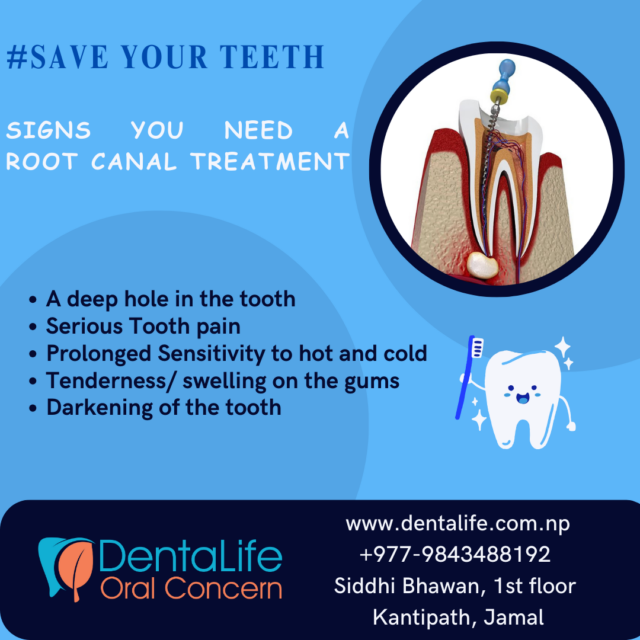
The following symptoms suggest you may need RCT and should visit a dentist promptly:
- Severe, persistent toothache — especially pain that throbs or wakes you at night
- Prolonged sensitivity to hot or cold — pain that lingers for more than 30 seconds after the stimulus is removed
- Pain on biting or chewing on a specific tooth
- Swelling of the gum near a tooth, or a small pimple-like bump on the gum (dental abscess)
- Darkening or discolouration of a tooth compared to adjacent teeth
- A loose tooth in an adult — can indicate bone loss from infection spreading
- A tooth that was previously painful but suddenly stops hurting — this can mean the nerve has died, but the infection may still be present and spreading
Not all infected teeth cause obvious pain. Some pulp infections are discovered only on routine X-rays. This is why regular dental check-ups are important even when you have no symptoms. -
Leaving a tooth that needs RCT untreated is dangerous. The infection does not resolve on its own — it progresses and spreads:
- Dental abscess: A pus-filled swelling forms at the root tip or in the surrounding bone — causing severe pain and swelling
- Spread to adjacent teeth: The bacterial infection can spread through the bone, affecting neighbouring healthy teeth
- Spread to the jaw, face, or neck: In severe cases, dental infections can spread into the facial spaces — a potentially life-threatening condition called Ludwig's angina
- Permanent tooth loss: Once the infection has destroyed enough supporting bone, the tooth cannot be saved and must be extracted
- Systemic infection: In immunocompromised patients, oral bacteria can enter the bloodstream and affect other organs
Avoiding RCT does not make the infection go away. Antibiotics can temporarily reduce symptoms but cannot eliminate a dental pulp infection — only root canal treatment or extraction can resolve it. The longer you wait, the more complex and costly the treatment becomes.
Laser-assisted RCT at DentaLife
-
In laser-assisted RCT, a dental laser is used during the disinfection stage of the root canal procedure — in addition to conventional irrigants and instruments — to achieve deeper and more thorough elimination of bacteria inside the root canal system.
Why this matters: Root canals are complex three-dimensional structures with tiny side branches (accessory canals) and microscopic dentinal tubules. Conventional chemical irrigants reach most areas but cannot fully penetrate all of these spaces. Laser energy can:
- Penetrate deeper into the dentinal tubule walls, eliminating bacteria that chemical disinfection cannot reach
- Disrupt and remove the smear layer (debris coating on canal walls) more effectively, improving the seal of the root canal filling
- Reduce post-operative pain and inflammation through photobiomodulation
- Speed up healing of the periapical (root tip) tissues
- Reduce the number of visits required in selected cases
At DentaLife, laser-assisted RCT is performed by our RCT specialist (Endodontist) at the same cost as regular RCT — there is no additional charge for laser use. -
No — laser-assisted RCT at DentaLife is done at no additional cost. The price is the same as conventional RCT.
Root Canal Treatment at DentaLife costs NPR 10,000 to NPR 16,000 depending on the location and complexity of the tooth:
- Front teeth (single-rooted, simpler anatomy) — towards the lower end of the range
- Back teeth / molars (multi-rooted, complex anatomy) — towards the higher end of the range
For the most current and tooth-specific pricing, visit our Prices & Services page or message us on WhatsApp before your appointment.
Note: The RCT fee covers the root canal procedure only. A dental crown is required after RCT and is charged separately. Your dentist will advise on the crown type and cost at the same appointment. -
At DentaLife, root canal treatment is performed by our Endodontist — a dental specialist with a postgraduate Masters degree (MDS) in Root Canal Therapy and Tooth Pain Management.
While general dentists can perform RCT, treatment by an endodontist is strongly recommended for better outcomes — particularly for:
- Teeth with complex root canal anatomy (curved, narrow, or calcified canals)
- Multi-rooted teeth (premolars and molars)
- Re-treatment cases where a previous RCT has failed
- Cases with severe infection or abscess
- Cases where previous treatment by a general dentist was incomplete
At DentaLife, specialist RCT with laser is available at the same cost as standard RCT at other clinics — making it exceptional value for the level of care provided.
Pain, visits & recovery
-
Modern root canal treatment is a painless procedure when performed correctly with adequate local anaesthesia. The procedure is performed under local anaesthesia, which fully numbs the tooth and surrounding area before any instruments are used.
A few important points about pain and RCT:
- Once the infected pulp is removed, the source of the toothache is eliminated — most patients feel immediate relief after the first RCT visit
- Mild soreness or tenderness around the tooth for 2–3 days after each visit is normal as the surrounding tissue heals — this is well-managed with standard over-the-counter pain relief
- In teeth with acute infections or abscesses, achieving full anaesthesia can occasionally be more challenging — in such cases, our specialists use additional techniques to ensure comfort throughout
- Laser use during RCT further reduces post-operative discomfort and speeds healing
The pain people associate with RCT is usually the pain before treatment — from the infected tooth itself. The procedure relieves this pain rather than causing it. -
The number of visits depends on the severity of the infection and the complexity of the tooth:
- Single-visit RCT: In selected cases with no active infection, no pus, and straightforward canal anatomy, the entire procedure can be completed in one appointment. This is made more achievable with laser disinfection.
- 2–3 visits: Most standard RCT cases. Visits are spaced 4–5 days apart.
- 3–4 visits: Required for teeth with active infection, pus, or abscess. The canals must be thoroughly disinfected and medicated between visits before final sealing.
- Re-RCT cases: Retreatment of a previously root-treated tooth typically requires more visits than a first-time RCT.
After the root canal is completed, a crown appointment is required at a separate visit to permanently restore the tooth.
Your DentaLife specialist will assess your tooth at the first appointment and give you a clear estimate of how many visits will be needed and the time interval between them. -
After RCT, the tooth is more brittle and vulnerable to fracture — particularly before the crown is placed. Follow these guidelines carefully:
✗ Do NOT do this ✓ Do this Do not chew hard food on the treated tooth — it can fracture the filling or the tooth itself Get a dental crown placed as soon as possible after RCT is completed Do not delay or skip the crown appointment Take prescribed antibiotics and pain relief as instructed by your dentist Do not bite on ice, hard candy, nuts, or bones on the treated side Eat soft foods and chew on the opposite side until the crown is placed Do not ignore persistent pain or swelling after treatment — contact the clinic Maintain good oral hygiene — brush and floss normally around the treated tooth Crown placement is not optional after RCT. A root-treated tooth without a crown has a significantly higher risk of fracture — which would then require extraction. The crown is what gives the tooth its long-term strength and lifespan. -
After root canal treatment, the tooth no longer has a living pulp to supply nutrients and moisture to the surrounding dentine. This makes the tooth significantly more brittle and prone to cracking under normal biting forces.
A dental crown placed over the root-treated tooth:
- Protects the tooth from fracture under biting and chewing forces
- Restores the full shape, appearance, and function of the tooth
- Seals the top of the tooth to prevent bacteria from re-entering the root canal system
- Significantly increases the long-term survival rate of the root-treated tooth
Without a crown, even a successfully treated root canal tooth can fracture within months — which would then require extraction. A crown should be placed as soon as possible after the root canal is completed — ideally within 2–4 weeks.
Interested in crowns? See our Dental Crown page for full details on types and pricing.
Single-visit RCT & retreatment (Re-RCT)
-
Single-visit RCT means the entire root canal procedure — access, cleaning, shaping, disinfection, and final sealing — is completed in one appointment rather than across multiple visits.
You may be suitable for single-visit RCT if:
- The pulp is vital (inflamed but not fully dead/infected) — irreversible pulpitis with no abscess
- There is no visible pus, active swelling, or acute infection
- The root canal anatomy is relatively straightforward (no severe curves or calcifications)
- The tooth is not a retreatment case
- You have scheduling constraints and prefer to complete treatment in one sitting
Single-visit RCT is not suitable when there is an abscess, active infection, complex anatomy, or if it is a retreatment case. In those situations, multiple visits ensure proper healing between appointments.
Laser-assisted disinfection at DentaLife makes single-visit RCT more achievable in appropriate cases — as the laser provides superior bacterial elimination in less time compared to conventional methods alone. -
Re-RCT (retreatment of root canals) is performed when a tooth that was previously root canal treated becomes reinfected or fails to heal properly. Even a well-performed RCT has a small chance of long-term failure.
Common reasons why a previously root-treated tooth may need retreatment:
- Incomplete cleaning during the original RCT — missed canals or incompletely instrumented canals
- New decay developing around the crown, allowing bacteria to re-enter the root canal
- A cracked, leaking, or broken crown allowing recontamination
- Extra or unusual roots that were missed during the initial procedure
- Delayed crown placement after original RCT — leaving the tooth exposed to reinfection
- Trauma to the tooth after original treatment
Re-RCT requires more visits than a first-time RCT and has a slightly lower success rate — but it remains a highly effective way to save the tooth. If retreatment fails, the alternatives are:
- Apicoectomy — a minor surgical procedure to remove the infected root tip
- Extraction and replacement with a dental implant or bridge
Alternatives & long-term outcomes
-
The only alternative to root canal treatment is tooth extraction — removing the infected tooth entirely. However, extraction creates a gap that needs to be filled to prevent the adjacent and opposing teeth from shifting, which leads to further dental problems.
After extraction, the missing tooth can be replaced with:
- Dental implant: The gold standard — a titanium root placed in the bone with a crown on top. Most natural-feeling and longest-lasting, but more expensive and requires surgery.
- Dental bridge: A fixed prosthesis that uses the adjacent teeth as anchors to support a false tooth in the gap. Less costly than an implant but requires grinding down healthy adjacent teeth.
- Removable partial denture: A removable appliance to fill the gap. The most affordable option but least comfortable and natural-feeling.
Preserving your natural tooth is always the first priority. All tooth replacement options are more expensive and require more treatment time than saving the original tooth with RCT. An implant, for example, costs significantly more than RCT plus a crown combined. -
A successfully treated and properly restored root canal tooth can last many years — potentially a lifetime — if properly maintained. Studies show very high long-term survival rates for root-treated teeth that are promptly crowned and maintained with good oral hygiene.
Key factors that determine how long the tooth lasts:
- Crown placement: The single most important factor — teeth crowned promptly after RCT survive far longer than those left without a crown
- Quality of the root canal treatment: Thorough cleaning and proper sealing reduces the risk of reinfection — which is why specialist treatment with laser at DentaLife provides better long-term outcomes
- Oral hygiene: Brushing twice daily, flossing, and regular scaling appointments prevent new decay from developing around the crown
- Avoiding excessive force: Not biting on very hard foods with the treated tooth
- Regular dental check-ups: Allows early detection of any issues with the crown or root
-
No — antibiotics cannot cure a dental pulp infection, and should never be used as a substitute for root canal treatment or extraction.
Here is why: Once the dental pulp becomes infected or dies, there is no blood supply inside the root canal to carry antibiotics to the site of infection. Antibiotics work through the bloodstream — but dead or infected pulp tissue has no circulation. This means antibiotics cannot reach or eliminate the bacteria inside the root canal.
What antibiotics can do:
- Temporarily reduce swelling and the spread of infection to surrounding tissues
- Help manage acute abscess symptoms before definitive dental treatment
Antibiotics are a temporary measure only — they do not treat the underlying cause. The infection will return once antibiotics are stopped unless the root canal is treated or the tooth is extracted.
Booking & clinic
-
Booking is easy — choose any of these options:
- WhatsApp (fastest): Message +977-9843488192 with your preferred date and time — we reply within 2 hours on working days (Sunday–Friday)
- Call us: Mobile +977-9843488192 · Landline +977-1-4163520
- Walk-in: We welcome walk-in patients — visit us at Kantipath, Jamal, Kathmandu, Sunday to Friday, 10AM–6PM
- Online: Use our online appointment form
If you are in severe pain or have visible facial swelling, come in or call us immediately — we prioritise emergency dental appointments. Do not wait for an online booking confirmation in an emergency.
Toothache or need RCT advice?
Message us your preferred date & time on WhatsAppDentaLife
Dental Clinic in Kathmandu





Copyright © 2026 by DentaLife Oral Concern Pvt. Ltd. – Dental Clinic in Kathmandu. +977-9843488192
Copyright © 2025 by DentaLife Oral Concern Pvt. Ltd – Dental Clinic in Kathmandu. All rights reserved.
+977-9843488192