
Laser Dental in Nepal
DentaLife Oral Concern is one of the first dental clinic in Nepal to incorporate latest technology in laser dentistry. To schedule an appointment, please call us:
Landline: +977-1-4163520 | Mobile: +977-9843488192
Visit Our Prices / Services Page for more details
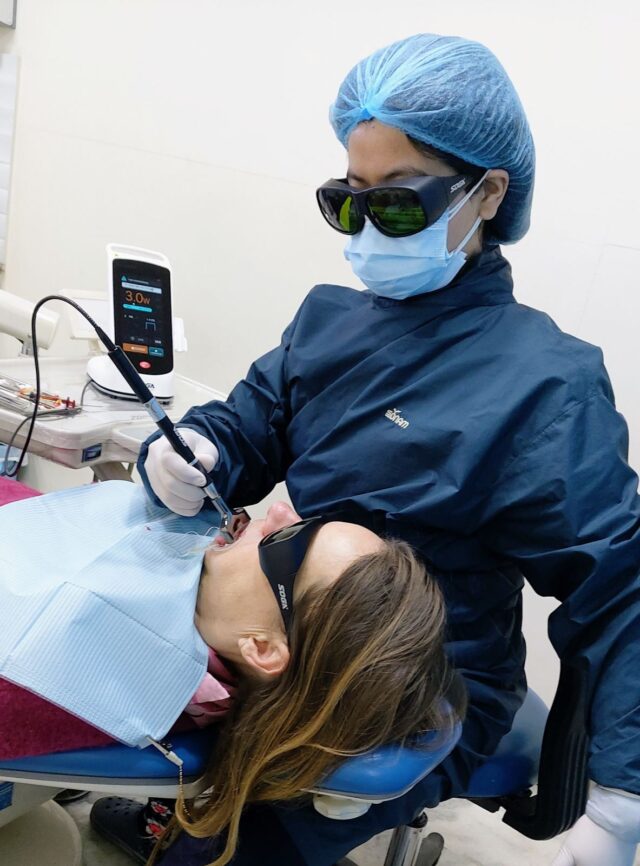
LASERS IN DENTISTRY
Laser dentistry is a minimally invasive dental technique that utilizes concentrated beams of light (laser) to perform various dental procedures. This technology offers several advantages over traditional methods, including reduced pain, minimal bleeding, and faster healing times. Laser dentistry can be used for a wide range of procedures, such as cavity detection, gum disease treatment, tooth whitening, and even surgical procedures like gum reshaping or removing oral lesions. Additionally, lasers can sterilize the treatment area, minimizing the risk of infection.
Overall, laser dentistry provides patients with a more comfortable and efficient dental experience.
Indication
It can be used in both hard and soft tissues.
In hard tissue:
- Laser assisted Teeth Bleaching,
- Teeth Desensitization
- Laser Therapy in TMJ pain
In soft tissue:
- Removal of soft tissues covering the impacted Or partially erupted tooth
- Photostimulation in recurrent herpetic lesion and aphthous ulcers
- Aesthetic gingival recontouring and crown lengthening
- Frenectomies
- Endodontic Germ Reduction
- Periodontal Germ Reduction
Advantages of Laser:
- Short healing time and quicker recovery: Laser dentistry operates with incredible precision, resulting in minimal trauma to the tooth, gum and surrounding tissues of the oral cavity.This translates to a reduced healing time compared to traditional techniques used for dental procedures. The entire process is almost pain-free with quicker recovery times.
- Specificity: Hence minimal tissue Damage. Due to the precise nature of laser treatments, the technology can preserve healthy areas of the teeth and surrounding structures.
- Less pain: As the treatment with laser is specific, less tissue is involved, hence less pain.
- Minimal to no post surgical bleeding and infection: When used for dental procedures, the laser’s high-energy beam causes blood coagulation to reduce blood loss. Also, since the laser beam sterilizes the affected area during the procedure, there is a lower risk of bacterial infection or complications.
- Minimal Time for Dental Treatment: Procedure with laser is comparatively fast compared to conventional procedures.
- Optimizable for patients: Depending on the type of dental treatment, the dentist can adjust the laser beam’s wavelength and power level to fit. This provides maximum control over the procedure and allows them to complete a dental treatment that serves the patient’s needs
- Minimally invasive process
Dental lasers are built to function without pressure, heat or continuous vibration, allowing dentists to perform dental procedures with little or no need for anesthesia. Lasers are minimally invasive and remove the need for dental drills. This means patients will feel lower pressure, ultimately reducing pain and discomfort during the procedure. Hence, patients experience less anxiety and can relax during the procedure.
Laser dentistry offers better results with reduced treatment duration. Patients will feel less discomfort during the procedure and will usually not require more invasive treatments. The dentist may provide this option along with conventional techniques or independent treatment. To learn more, book an appointment with the dental office today.
Treatment With Lasers
1. Laser Teeth Whitening
Laser teeth whitening is a 20 – 30 minutes procedure that must be carried out in a dental clinic. The process is similar to conventional bleaching, except that a special light is used to speed up the oxidation of oxygen molecules.
How is it done?
- The dentist gives you protective glasses for your eyes and places a cheek retractor into your mouth.
- A protective gel (light-cured resin material) is applied to the gums to protect them from the bleaching gel.
- An intensely concentrated peroxide-based whitening gel is then applied directly onto your teeth.
- After a couple of minutes, a diode laser is then used to activate the gel.
- This whole process can be done 2-3 times until the desired shade of the tooth is obtained.
Advantages of laser teeth whitening:
- Laser teeth whitening is incredibly powerful and long lasting
- Whitening sessions are quick—each one takes around 10 – 15 minutes.
- You’ll probably see immediate results that are more dramatic than those of standard bleaching techniques.
- Medical professionals perform these procedures, so you can be sure they are safe and effective.
Can Laser teeth Whitening Damage Your Teeth?
Laser whitening cannot damage your teeth. Since tooth enamel is hard tissue, the peroxide used in laser whitening solutions does not damage it.
2. Laser gum Depigmentation
WHAT IS LASER GUM DEPIGMENTATION?
Just as people have different skin tones, so can people have different gum tones. Although dark gums may be healthy, some patients find them unattractive and seek measures to lighten them.
Gum depigmentation (GD) is a minor surgical procedure used to remove or reduce excessive pigmentation applying various treatment methods among which most recently numerous types of lasers are used.
It restores the gums to an aesthetic, pink color.
What Makes the Gums Dark?
Melanin is the pigment responsible for skin color. Gums also produce melanin. Excessive amounts of melanin makes the gum dark.
What Happens During Laser Gum Depigmentation?
During the treatment, your dentist uses a soft tissue laser to remove the excess pigment from your gums under local anesthesia.
The procedure takes 30 min to 1 hour and is nearly painless. Most people get the results they were hoping for after just a single treatment session.
Laser gum depigmentation has been recognized recently as the most effective, pleasant and reliable technique.
Advantages with laser gum depigmentation
- Easy handling
- Short treatment time
- Accelerate wound healing
- No or very limited bleeding
- Minimal Pain
- No need of sutures or surgical dressing
- Sterilization Effect

3. Lasers in Teeth desensitization
What is Dentin Hypersensitivity ?
Dentine HyperSensitivity (DHS) is one of the most commonly encountered dental problems that causes discomfort and sometimes severe pain.
Hypersensitivity may be present on one specific tooth, in one area of the mouth, or several teeth. It can significantly affect an individual’s quality of life, impede effective oral hygiene, and subsequently affect aesthetics.
What are the Main Causes for DHS?
Dentin is covered by enamel in the crown region and by cementum in the root region. When the enamel or cementum is lost, the underlying dentin will be exposed along with the dentine tubules, producing dentin hypersensitivity.
Any reason that removes enamel / cementum leads to Dentin Hypersensitivity, most common being hard tooth brushing, gum recession.
As a result pain, pressure, and hot and cold stimuli can travel down the tubules triggering the nerve. Conventional desensitizing agents like toothpastes and mouthwashes aim to obliterate the exposed pores or tubules but take a while to work and must constantly be used. Apart from the traditional ways, recently dental laser for teeth desensitization has been common. Laser teeth desensitization is an efficient tool for the immediate treatment of tooth hypersensitivity.
Lasers have been proven to be effective at decreasing or even eliminating dental sensitivity. It directs the laser energy into the sensitive areas and the laser suppresses the potential of the nerve fibers by sealing the tubules.
How it is done?
It is a simple procedure which requires no anesthetic. In our office, we do this fast, cost effective and pain free procedure with a high success rate.
The use of a dental laser may make you feel more comfortable and less anxious during your treatments. If you are interested in learning more about procedures that use dental laser technology, please contact us.
4. Laser in gummy smile correction
5. Laser in TMJ pain
Frequently Asked Questions
Laser Dentistry in Nepal — Your Questions Answered
Everything you need to know about laser dental treatments at DentaLife Oral Concern, Kathmandu — one of the first clinics in Nepal to offer laser dentistry.
General laser dentistry
-
Laser dentistry is a minimally invasive dental technique that uses concentrated beams of focused light (laser energy) to perform dental procedures on both hard tissues (teeth) and soft tissues (gums). The laser replaces or supplements conventional instruments such as drills and scalpels.
Depending on the wavelength and power settings, the laser energy can:
- Cut or reshape gum and other soft tissue with minimal bleeding
- Activate and accelerate whitening gels on teeth
- Seal dentinal tubules to eliminate tooth sensitivity
- Destroy bacteria in periodontal pockets and root canals
- Stimulate tissue healing through photobiomodulation (low-level laser therapy)
- Remove pigmented cells from gum tissue for cosmetic improvement
DentaLife Oral Concern is one of the first dental clinics in Nepal to incorporate laser technology, offering patients a more comfortable and precise alternative to traditional methods.
-
At DentaLife, lasers are used for both hard tissue and soft tissue procedures:
- Hard tissue: Laser-assisted teeth whitening / bleaching, teeth desensitisation (dentin hypersensitivity treatment), and TMJ (jaw joint) pain therapy
- Soft tissue: Laser gum depigmentation (dark gum treatment), gummy smile correction, frenectomy (removal of tongue-tie or lip-tie), aesthetic gingival recontouring and crown lengthening, removal of soft tissue covering impacted or partially erupted teeth, photostimulation for recurrent herpetic lesions and aphthous ulcers (mouth ulcers), and periodontal and endodontic germ reduction
If you are unsure whether laser treatment is suitable for your specific concern, our dentists will advise the best approach during your consultation. -
Laser dentistry offers significant advantages over conventional dental techniques:
- Less pain: Laser treatments are specific and minimise the tissue involved — resulting in less pain during and after the procedure. Many laser procedures require little or no anaesthesia.
- Minimal bleeding: The laser beam causes blood coagulation on contact, dramatically reducing bleeding during soft tissue procedures. No sutures are usually needed.
- Faster healing: Minimal trauma to surrounding tissue means the body heals significantly faster than after conventional surgery.
- Lower infection risk: The laser beam sterilises the treatment area during the procedure, reducing the risk of bacterial infection and post-operative complications.
- Precision: Laser energy can target only the affected tissue, preserving the surrounding healthy teeth and gum tissue.
- Less anxiety: No drilling noise, no vibration, and no pressure — patients are more relaxed and comfortable throughout.
- Faster treatment: Many laser procedures are significantly quicker than their conventional equivalents.
- Adjustable: The dentist can precisely adjust the laser wavelength and power level to match each individual procedure and patient.
-
Yes — laser dentistry is safe when performed by trained dental professionals using calibrated equipment. It is a well-established, internationally recognised field of dentistry used widely in clinics across the world.
Safety measures followed at DentaLife include:
- Protective eyewear is provided to both the patient and the dental team before every laser procedure
- Laser wavelength and power are carefully set by the dentist for each specific procedure and tissue type
- Gum-protective barriers (light-cured resin) are applied where required to shield adjacent soft tissue
As with any procedure, individual risks are assessed during consultation. Laser treatment is not suitable for some patients — for example, those on certain medications or with specific systemic conditions — and your dentist will evaluate suitability before proceeding.
-
Many laser procedures at DentaLife require little or no anaesthesia — which is one of their major advantages over conventional treatments.
- Laser teeth whitening: No anaesthesia needed
- Laser teeth desensitisation: No anaesthesia — the procedure is completely pain-free
- Laser gum depigmentation: Performed under local anaesthesia for comfort
- Laser frenectomy / gum recontouring: Usually local anaesthesia is applied
- Photostimulation for ulcers: No anaesthesia needed
- TMJ laser therapy: No anaesthesia needed
Dental lasers operate without pressure, heat, or vibration — the three main triggers of dental anxiety — which means patients feel significantly less discomfort and anxiety even without anaesthesia.
Laser teeth whitening
-
Laser teeth whitening uses the same concentrated peroxide whitening gel as conventional bleaching — but a diode laser is directed at the gel to activate and accelerate the oxidation reaction, producing faster and more dramatic whitening in less time.
The step-by-step procedure:
- Protective glasses are placed over your eyes
- A cheek retractor is placed to keep lips and cheeks away from the gel
- A light-cured protective resin is applied to the gums to shield them
- Concentrated peroxide whitening gel is applied directly onto your teeth
- The diode laser is directed at the gel for activation — each round takes 10–15 minutes
- The process is repeated 2–3 times until the desired tooth shade is achieved
Total procedure time: approximately 20–30 minutes. Results are visible immediately on the same day.
Laser whitening at DentaLife costs NPR 22,000. Regular whitening without laser is NPR 18,000. See our Teeth Whitening page for full details. -
No — laser whitening cannot damage your teeth. Tooth enamel is a hard, mineralised tissue and the peroxide concentration used in professional whitening solutions does not chemically alter enamel structure.
The laser simply activates the whitening gel — it does not contact the tooth surface directly during the whitening procedure. The oxidation process targets only organic pigment molecules within the enamel and dentin, leaving the hard tissue completely intact.
All whitening procedures at DentaLife are supervised and performed by our trained dentists, ensuring safe concentrations and correct technique throughout.
Laser gum depigmentation (dark gums)
-
Laser gum depigmentation is a minor cosmetic dental procedure that removes or reduces dark or uneven pigmentation from the gum tissue, restoring gums to a healthy, aesthetic pink colour.
Just as people have different skin tones, gums naturally vary in colour. Dark gums are caused by excess melanin — the same pigment responsible for skin colour. While dark gums are medically healthy, many patients find them aesthetically undesirable, especially when they are visible when smiling.
Laser gum depigmentation is ideal for patients who:
- Have dark brown or black patches on their gums affecting their smile aesthetics
- Feel self-conscious about dark gums when smiling or speaking
- Want a more uniform, pink gum colour to complement their teeth
- Have tried other treatments without success — laser is currently the most effective method
Laser gum depigmentation has been recognised as the most effective, pleasant, and reliable technique available for this treatment — with most patients achieving the desired result in a single session. -
The procedure is performed under local anaesthesia, making it nearly painless throughout. Here is what to expect:
- Local anaesthetic is applied to numb the gum tissue
- A soft tissue laser is used to ablate (remove) the excess melanin-containing cells from the surface layer of the gum
- The laser simultaneously coagulates blood vessels — so there is minimal to no bleeding
- No sutures or surgical dressings are needed
- The full procedure takes 30 minutes to 1 hour
After the anaesthetic wears off, mild soreness is normal for a day or two. Most patients heal quickly and comfortably, and can return to normal activities the same day.
Most patients achieve their desired result after just one session. Some cases with very heavy pigmentation may benefit from a follow-up session after healing is complete. -
Results from laser gum depigmentation are long-lasting. The laser removes melanocytes (melanin-producing cells) from the surface of the gum tissue — after which the gums heal to a lighter, uniform pink colour.
However, it is important to know that melanocytes can repopulate over time, and some patients may experience re-pigmentation after months or years. The likelihood and speed of re-pigmentation depends on:
- Individual melanin production levels (skin tone and genetics)
- Smoking — nicotine significantly stimulates melanocyte activity and is the most common cause of re-pigmentation
- Sun exposure
- Certain medications
Patients who smoke are advised to stop before and after the procedure — both for better healing and to significantly slow any re-pigmentation.
Laser teeth desensitisation
-
Laser teeth desensitisation is a fast, pain-free treatment for dentine hypersensitivity (DHS) — the sharp pain or discomfort triggered by hot, cold, sweet, or acidic stimuli on sensitive teeth.
Dentine hypersensitivity occurs when the enamel or cementum protecting the tooth is worn away, exposing the underlying dentine and the microscopic dentinal tubules within it. Stimuli (temperature, pressure, sweet or sour substances) travel through these open tubules and trigger the tooth nerve — causing pain.
Laser desensitisation works by directing laser energy into the sensitive areas. The laser seals (obliterates) the open dentinal tubules and suppresses the activity of the nerve fibres — providing immediate and often long-lasting relief from sensitivity.
Unlike desensitising toothpastes which must be used continuously and take weeks to show effect, laser desensitisation provides immediate results in a single, fast, pain-free procedure. -
Any condition or habit that removes enamel or cementum from the tooth surface can lead to dentine hypersensitivity. The most common causes include:
- Hard toothbrushing: The most common cause — abrasive brushing erodes enamel at the gum line
- Gum recession: Exposes the root surface (covered by cementum rather than enamel), which is thinner and more sensitive
- Teeth grinding (bruxism): Wears down enamel, especially on biting surfaces
- Acidic food and drinks: Erode enamel over time
- Recent dental procedures: Scaling, whitening, or fillings can temporarily increase sensitivity
- Cracked teeth: Expose dentine tubules directly
- Gum disease: Causes bone and gum recession, exposing root surfaces
Sensitivity may affect a single tooth, one area, or multiple teeth simultaneously. In all cases, our dentists will identify the underlying cause and recommend the most appropriate treatment.
-
Laser desensitisation is completely painless and requires no anaesthesia. It is one of the most patient-friendly procedures in modern dentistry.
- The procedure is fast — typically completed in one short appointment
- The laser is directed at the sensitive tooth surfaces without any drilling, pressure, or discomfort
- Most patients notice a significant reduction or complete elimination of sensitivity immediately after the procedure
- No recovery time is needed — you can eat and drink normally after the appointment
At DentaLife, laser desensitisation is performed as a cost-effective, fast, and high-success-rate procedure. It can be combined with other treatments during the same visit.
Gummy smile correction, TMJ & other laser treatments
-
Yes — laser gummy smile correction (aesthetic gingival recontouring) is one of the most popular laser cosmetic procedures at DentaLife. A gummy smile is when an excessive amount of gum tissue shows above the teeth when smiling, making the teeth appear short.
Using a soft tissue laser, the dentist precisely removes and reshapes the excess gum tissue to reveal more of the natural tooth crown — creating a more balanced, aesthetic smile. Key advantages of laser gummy smile correction:
- Precise contouring — the dentist can control exactly how much gum is removed
- Minimal bleeding due to laser coagulation
- No sutures required in most cases
- Faster healing than conventional gum surgery
- Results visible immediately after the procedure
For some patients, a gummy smile is caused by the jaw bone position rather than excess gum tissue alone — a consultation will determine whether laser recontouring alone or a combined approach is most suitable for you. -
The temporomandibular joint (TMJ) connects the jawbone to the skull on each side of the face. TMJ disorders cause pain and dysfunction in the jaw joint and the muscles controlling jaw movement — leading to jaw pain, clicking, headaches, difficulty chewing, and limited mouth opening.
Low-level laser therapy (LLLT) — also called photobiomodulation — is used at DentaLife to treat TMJ pain. The laser energy penetrates the joint tissues and:
- Reduces inflammation in the joint capsule and surrounding muscles
- Improves local blood circulation, accelerating tissue repair
- Relieves muscle spasm and reduces associated pain
- Stimulates cell regeneration in damaged joint tissue
Laser TMJ therapy is non-invasive, painless, and requires no anaesthesia. It is often used alongside other TMJ management approaches such as occlusal splints or physiotherapy for the best outcome.
-
Yes — low-level laser photostimulation is an effective treatment for both recurrent aphthous ulcers (mouth ulcers) and recurrent herpetic lesions (cold sores inside or around the mouth).
The laser energy stimulates tissue healing through photobiomodulation — the same mechanism used in TMJ therapy. Applied to ulcers or herpetic lesions, it:
- Significantly reduces pain from the ulcer — often immediately after the procedure
- Accelerates healing, shortening the duration of the ulcer
- Reduces the frequency of recurrence when applied at the early (tingling/prodromal) stage of a lesion
The procedure is painless and takes only a few minutes. If you suffer from frequent mouth ulcers or recurring cold sores, laser photostimulation is a fast, effective relief option available at DentaLife.
-
A frenectomy is a procedure to remove or release the frenum — a small fold of tissue that connects the lips, cheeks, or tongue to the gum or floor of the mouth. A frenectomy is needed when an oversized or tight frenum causes problems such as:
- Tongue-tie (ankyloglossia): A tight lingual frenum restricts tongue movement, causing difficulty with speech, breastfeeding in infants, or oral hygiene
- Lip-tie: A thick labial frenum pulls on the gum between the front teeth, causing a gap (diastema) or gum recession
- Denture discomfort: A frenum attachment interfering with a denture fit
Laser frenectomy replaces the conventional scalpel procedure with precise laser tissue removal. Advantages include minimal bleeding, no sutures in most cases, faster healing, and significantly less post-operative discomfort than conventional surgery.
Booking & clinic
-
DentaLife Oral Concern at Kantipath, Jamal, Kathmandu is one of the first dental clinics in Nepal to incorporate laser technology into clinical practice. We offer a wide range of laser procedures across both hard and soft tissue treatments — making us one of the most comprehensive laser dental providers in the country.
Our team of certified dentists is trained in the safe and effective use of dental lasers, and the equipment is regularly maintained and calibrated to international standards.
-
Booking is quick — choose any of these options:
- WhatsApp (fastest): Message +977-9843488192 with your preferred date and time and the treatment you are interested in — we reply within 2 hours on working days (Sunday–Friday)
- Call us: Mobile +977-9843488192 · Landline +977-1-4163520
- Walk-in: Visit us at Kantipath, Jamal, Kathmandu — Sunday to Friday, 10AM–6PM
- Online: Use our online appointment form
Not sure which laser treatment is right for you? Come in for a consultation and our dentists will assess your concerns and recommend the most suitable procedure.
Interested in laser dental treatment?
Message us your preferred date & time on WhatsAppDentaLife
Dental Clinic in Kathmandu





Copyright © 2026 by DentaLife Oral Concern Pvt. Ltd. – Dental Clinic in Kathmandu. +977-9843488192
Copyright © 2025 by DentaLife Oral Concern Pvt. Ltd – Dental Clinic in Kathmandu. All rights reserved.
+977-9843488192